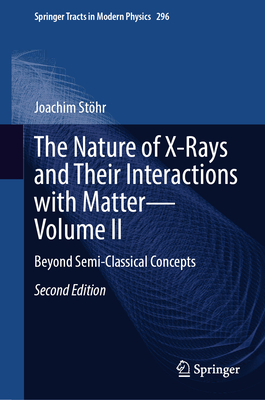
Volume II of the second edition, subtitled Beyond Semi-Classical Concepts, expands the description of x-rays into the framework of quantum optics, rooted in the full theory of light and matter: quantum electrodynamics (QED). Following a brief introduction, the book is organized into three parts and an appendix. Part I explores the description of x-rays and diffraction phenomena within the advanced formalism of quantum optics. The discussion extends conventional quantum mechanics, which treats photons as independent particles, to higher-order quantum states containing multiple photons. A central theme is the emerging paradigm that quantum states with two or more photons can be directly observed in diffraction experiments using multi-photon detection. This makes it possible to overcome constraints of the classical framework, such as the diffraction limit, and to probe novel effects including photon-photon entanglement and interference. Part II presents the quantum formulation of weak photon-matter interactions using the Kramers-Heisenberg-Dirac perturbation framework. This is applied to polarization-dependent, first-principles descriptions of interaction cross sections for x-ray absorption and dichroism, x-ray emission, Thomson scattering, and both resonant elastic (REXS) and inelastic (RIXS) scattering. A new section introduces the derivation of cross sections for two-photon x-ray absorption and ionization. Part III extends the discussion from weak to strong interactions of x-rays with atoms and solids. Topics include the time-dependent transfer of x-ray energy to the electronic system and the lattice, the challenges of sample damage, and the intriguing phenomenon of x-ray transparency. Resonant core-to-valence excitations are analyzed using the optical Bloch equations, revealing effects such as Rabi oscillations of electronic populations and the intensity-dependent emergence of stimulated x-ray scattering. An extensive appendix provides reference materials, including units and physical constants, the calculation of electronic transition matrix elements, and a survey of important quantum states of light and their matrix elements with photon creation and destruction operators encountered in the quantum formulation of diffraction.
第二版的第二卷,副標題為《超越半經典概念》,將X射線的描述擴展到量子光學的框架中,根植於光與物質的完整理論:量子電動力學(QED)。在簡短的介紹之後,本書分為三個部分和一個附錄。
第一部分探討在量子光學的高級形式主義下對X射線和衍射現象的描述。討論將傳統量子力學(將光子視為獨立粒子)擴展到包含多個光子的高階量子態。一個核心主題是新興的範式,即具有兩個或更多光子的量子態可以在使用多光子檢測的衍射實驗中被直接觀察到。這使得克服經典框架的限制(如衍射極限)成為可能,並探測包括光子-光子糾纏和干涉等新穎效應。
第二部分使用克拉默斯-海森堡-狄拉克擾動框架呈現弱光子-物質相互作用的量子表述。這應用於依賴於偏振的X射線吸收和二色性、X射線發射、湯姆森散射,以及共振彈性(REXS)和非彈性(RIXS)散射的相互作用截面的第一原理描述。一個新部分介紹了兩光子X射線吸收和電離的截面推導。
第三部分將討論從X射線與原子和固體的弱相互作用擴展到強相互作用。主題包括X射線能量向電子系統和晶格的時間依賴轉移、樣品損壞的挑戰,以及X射線透明度的有趣現象。使用光學布洛赫方程分析共振的核心到價電子激發,揭示了電子族群的拉比振盪和強度依賴的刺激X射線散射的出現等效應。
一個廣泛的附錄提供參考材料,包括單位和物理常數、電子躍遷矩陣元素的計算,以及重要光的量子態及其與在衍射的量子表述中遇到的光子創造和消滅算符的矩陣元素的調查。
以上中文內容由 AI 翻譯