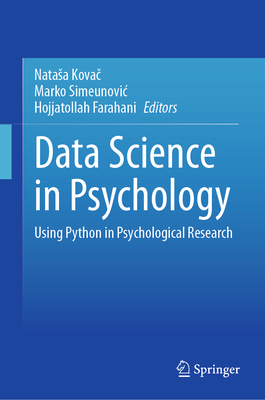
Data Science in Psychology: Using Python in Psychological Research
暫譯: 心理學中的數據科學:在心理研究中使用 Python
Kovač, Natasa, Simeunovic, Marko, Farahani, Hojjatollah
相關主題

商品描述
This book is an innovative resource designed to bridge the gap between traditional psychological research methods and contemporary data science techniques. This book provides a comprehensive introduction to using Python for analyzing psychological data, enabling researchers, educators, and students to harness the analytical power of data science within their work. The volume is structured into four parts, encompassing programming skills, data preparation, advanced data processing, and the interpretation of results, each reinforced with practical examples and case studies.
The content starts with the basics of Python programming, tailored specifically for psychological research applications. It then progresses to the sophisticated analysis of psychological data using statistical models, machine learning, and artificial intelligence, with a strong focus on Python's capabilities in these areas. This includes detailed discussions on Confirmatory Factor Analysis, machine learning algorithms like SVMs, and innovative techniques such as metaheuristics and simulations.
This book is particularly timely as psychological research becomes increasingly data-driven, necessitating a deeper understanding of complex datasets and the development of more sophisticated analytical tools. "Data Science in Psychology" addresses this need by providing not only the technical skills required but also a deep understanding of how these techniques can be applied specifically to psychological research. The primary audience, including psychology researchers, academics, and advanced students, will find this book invaluable for integrating data science into their daily toolkit, thus leveling up their research capabilities and broadening their methodological approaches in an era where interdisciplinary skills are an added value.
商品描述(中文翻譯)
這本書是一個創新的資源,旨在彌合傳統心理學研究方法與當代數據科學技術之間的鴻溝。本書提供了使用 Python 分析心理學數據的全面介紹,使研究人員、教育工作者和學生能夠在其工作中利用數據科學的分析能力。本書分為四個部分,涵蓋程式設計技能、數據準備、高級數據處理和結果解釋,每個部分都配有實用的範例和案例研究。
內容從 Python 程式設計的基礎開始,專門針對心理學研究應用進行調整。接著進入使用統計模型、機器學習和人工智慧對心理學數據進行複雜分析的部分,強調 Python 在這些領域的能力。這包括對確認性因素分析、支持向量機(SVM)等機器學習演算法以及元啟發式和模擬等創新技術的詳細討論。
隨著心理學研究日益數據驅動,對複雜數據集的深入理解和更高級分析工具的開發變得愈加重要,因此這本書的出版時機恰到好處。《心理學中的數據科學》滿足了這一需求,不僅提供所需的技術技能,還深入理解這些技術如何具體應用於心理學研究。主要讀者包括心理學研究人員、學者和高級學生,將會發現這本書對於將數據科學整合進他們的日常工具箱是無價的,從而提升他們的研究能力,並在跨學科技能被視為附加價值的時代中擴展他們的方法論。
作者簡介
Natasa Kovač (https: //orcid.org/0000-0002-6671-2938) is an assistant professor at the Faculty of Applied Sciences, University of Donja Gorica. She defended her PhD thesis entitled "Metaheuristic approach to solving a class of optimization problems in transport" at the Faculty of Mathematics, University of Belgrade, and at the same time acquired the title of Doctor of Mathematics. She was employed at the Faculty of Technical Sciences in Novi Sad and the Faculty of Maritime Studies in Kotor as an assistant. She worked as a lecturer at the Mediterranean University in Podgorica, and she also taught as a professor at the Gymnasium in Kotor. She is currently employed at the Faculty of Applied Sciences in Podgorica where she teaches Euclidean and analytical geometry, stochastic processes and probability and mathematical statistics. Her research interests are statistical analysis, metaheuristics, optimization, algorithm development, and applied mathematics in engineering sciences. She has specializations in data science and was awarded the following certifications: Certified Data Collection and Processing with Python (University of Michigan), Statistics with Python specialization (University of Michigan), Introduction to Data Science specialization (IBM), Applied Data Science specialization (IBM), and IBM Data Science specialization (IBM). She has published more than 80 scientific papers and has been involved in more than 10 international projects. She is one of the founders of the SME "MoDrone" supported by the Montenegrin government, which is dedicated to the development and promotion of innovative solutions. She is a full member of the Scientific Research Honor Society Sigma Xi.
Marko Simeunovic received the B.Sc., M.Sc., and Ph.D. degrees in electrical engineering from the Faculty of Electrical Engineering of the University of Montenegro, in 2008, 2009 and 2013 respectively. From 2008 to 2016 he was with the University of Montenegro covering positions of teaching/research assistant and was an ICT fellow specializing in e-service engineering. In 2016 he was also involved in the first Center of Excellence in Montenegro. He joined the University of Donja Gorica in 2016 where he is currently holding the position of associate professor. From 2020 to 2022 he was with the Department of Town Planning, Engineering Networks and Systems of the Institute of Architecture and Construction, South Ural State University, Chelyabinsk, Russia where he was associate professor. His courses are related to electrical engineering, programming, artificial intelligence, information systems and digital signal and image processing. He published more than 60 papers in international scientific journals and conferences and participated in several FP7, H2020, bilateral and national research projects. He was a leader of two innovative projects funded by the Ministry of Science of Montenegro. Marko Simeunovic is a reviewer with most of the world's leading journals on signal processing. In 2013, Dr Simeunovic was honoured by the Montenegrin Academy of Sciences and Arts for his outstanding scientific achievements. His research interests include time-frequency signal analysis, robust estimation, parametric and nonparametric estimation, statistical and array signal processing, genetic algorithm applications, radar signal processing and wireless sensor networks. More information can be found at http: //markosimeunovic.optimussoft.me/.
Hojjatollah Farahani is an Assistant Professor at the Tarbiat Modares University (TMU), Iran. He received his Ph.D. from Isfahan University in 2009, and he was a postdoctoral researcher in Fuzzy inference at Victoria University in Australia (2014-2015), where he started working on Fuzzy Cognitive Maps (FCMs) under the supervision of Professor Yuan Miao. He is the author or co-author of more than 200 research papers and a reviewer in numerous scientific journals. He has supervised and advised many theses and dissertations in psychological sciences. His research interests and directions include psychometrics, advanced behavioral statistics, fuzzy psychology, artificial intelligence, and machine learning algorithms in psychology. His recent book entitled "An Introduction to Artificial Psychology: Application Fuzzy Set Theory and Deep Machine Learning in Psychological Research using R" was published by Springer in 2023.
作者簡介(中文翻譯)
Natasa Kovač (https://orcid.org/0000-0002-6671-2938) 是多尼亞戈里察大學應用科學院的助理教授。她在貝爾格萊德大學數學院辯護了題為「元啟發式方法解決運輸優化問題的一類」的博士論文,並同時獲得數學博士學位。她曾在諾維薩德的技術科學院和科托爾的海事學院擔任助理。她曾在波德戈里察的地中海大學擔任講師,並在科托爾的高中擔任教授。她目前在波德戈里察的應用科學院任教,教授歐幾里得幾何、解析幾何、隨機過程、概率及數學統計。她的研究興趣包括統計分析、元啟發式方法、優化、算法開發以及工程科學中的應用數學。她在數據科學方面有專業資格,並獲得以下認證:使用 Python 的數據收集與處理認證(密西根大學)、使用 Python 的統計專業(密西根大學)、數據科學入門專業(IBM)、應用數據科學專業(IBM)以及 IBM 數據科學專業(IBM)。她已發表超過 80 篇科學論文,並參與超過 10 個國際項目。她是由黑山政府支持的中小企業「MoDrone」的創始人之一,該企業致力於創新解決方案的開發與推廣。她是科學研究榮譽學會 Sigma Xi 的正式成員。
Marko Simeunovic 於 2008、2009 和 2013 年分別在黑山大學電氣工程學院獲得電氣工程的學士、碩士和博士學位。從 2008 年到 2016 年,他在黑山大學擔任教學/研究助理,並專注於電子服務工程的 ICT 研究員。2016 年,他還參與了黑山的第一個卓越中心。他於 2016 年加入多尼亞戈里察大學,目前擔任副教授。從 2020 年到 2022 年,他在俄羅斯車里雅賓斯克的南烏拉爾國立大學建築與建設研究所的城市規劃、工程網絡與系統系擔任副教授。他的課程與電氣工程、程式設計、人工智慧、資訊系統以及數位信號和影像處理相關。他在國際科學期刊和會議上發表了超過 60 篇論文,並參與了多個 FP7、H2020、雙邊和國家研究項目。他是由黑山科學部資助的兩個創新項目的負責人。Marko Simeunovic 是大多數世界領先的信號處理期刊的審稿人。2013 年,Simeunovic 博士因其卓越的科學成就獲得黑山科學藝術院的榮譽。
Hojjatollah Farahani 是伊朗塔爾比亞特莫達雷斯大學 (TMU) 的助理教授。他於 2009 年在伊斯法罕大學獲得博士學位,並於 2014 至 2015 年在澳大利亞維多利亞大學擔任模糊推理的博士後研究員,在教授 Yuan Miao 的指導下開始研究模糊認知地圖 (FCMs)。他是超過 200 篇研究論文的作者或合著者,並在多個科學期刊擔任審稿人。他指導和建議了許多心理科學的論文和學位論文。他的研究興趣和方向包括心理測量、高級行為統計、模糊心理學、人工智慧以及心理學中的機器學習算法。他最近出版的書籍《人工心理學導論:使用 R 的模糊集理論和深度機器學習在心理研究中的應用》於 2023 年由施普林格出版。