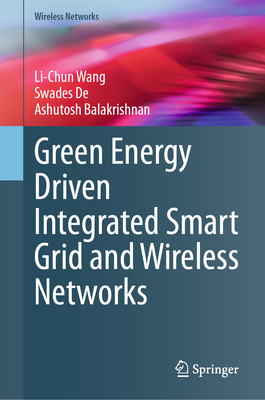
Green Energy Driven Integrated Smart Grid and Wireless Networks
暫譯: 綠能驅動的整合智慧電網與無線網路
Wang, Li-Chun, de, Swades, Balakrishnan, Ashutosh
- 出版商: Springer
- 出版日期: 2026-07-14
- 售價: $8,390
- 貴賓價: 9.5 折 $7,970
- 語言: 英文
- 頁數: 140
- 裝訂: Hardcover - also called cloth, retail trade, or trade
- ISBN: 3032205085
- ISBN-13: 9783032205087
-
相關分類:
Wireless-networks
海外代購書籍(需單獨結帳)
相關主題


商品描述
This book outlines the design of green energy driven, integrated smart grid and wireless networks. It also explores the integration of renewable energy with the traditional power grid. The core idea is to enable each grid user to be a potential energy source for the grid, thereby revising the conventional idea of power grids. A grid networked system of such distributed ambient powered nodes can potentially act as a carbon-free energy producer system to the power grid in addition to an energy prosumer system. The need for this book stems from increased power consumption in contemporary communication systems, the inflexibility of the traditional power grid, and the non-scalability of standalone green communication systems
Chapter 1 outlines the upcoming research theme of 6G communications and highlights the importance of sustainability. From a beginner's perspective, Chapter 3 presents insights on the design constraints and challenges in system analysis. It details the inherent cost metrics and network operations associated with ambient powered tele-networks. Chapter 2 acts as a benchmark, wherein a detailed design and performance evaluation in purely off-grid solar powered base stations is presented. The chapter includes insights on the outage prone-ness of ambient powered nodes and presents a Markovian framework to estimate the outages through first principles. Chapter 4 and Chapter 5 present an in-depth analysis of grid networked and ambient powered telecommunication networks, presenting optimal amounts of energy which the nodes can share among each other or trade with the grid. Chapter 4 first presents a cooperative energy balancing based framework among the networked nodes. Through energy balancing, the improvement in network green energy utilization is shown, thereby realizing carbon free green networks. Chapter 5 analyzes the ambient powered and networked system from an operator perspective. By incorporating revenue awareness, it illustrates the beneficial effects of energy balancing and its complementarity to load balancing, aiding the scalability of green solutions from an industry perspective. From a system perspective, a joint load-energy balancing is studied, showing insights on the operator revenue being influenced by user service and network green energy utilization.
Chapter 6 showcases an aerial-terrestrial green network design, wherein the inherent coupling between the data and energy networks of the system are studied. As a case study, system performance is evaluated for a aerial base station (BS) aided terrestrial network. Chapter 7 demonstrates a wider perspective of the energy balancing in networks, through a residential setting. It is worthwhile to note that the concept of energy balancing can be easily extended to energy aware network design, including ambient internet of things (IoT), wireless sensor networks, or green data center networks. Chapter 8 presents a glimpse of green artificial intelligence (AI) aided future networks. The key research directions wireless communication networks are showcased, wherein AI can be used to improve upon the current state of art. The chapter also gives a detailed discussion on upcoming green AI models, the tradeoff between energy efficiency and AI performance, and the need to develop computationally light and efficient AI models for future networks.
This book targets advanced-level students in computer science and electrical engineering focused on this topic. Professionals scaling green service provisioning solutions to large networks will also find this book useful as a reference.
商品描述(中文翻譯)
這本書概述了以綠色能源驅動的整合智慧電網和無線網絡的設計。它還探討了可再生能源與傳統電網的整合。核心理念是使每個電網用戶都能成為電網的潛在能源來源,從而修正傳統電網的觀念。這種分散式環境供電節點的網絡系統除了作為能源生產者系統外,還可以作為無碳能源生產系統。這本書的需求源於當代通信系統中不斷增加的電力消耗、傳統電網的僵化以及獨立綠色通信系統的不可擴展性。
第一章概述了即將到來的6G通信研究主題,並強調可持續性的的重要性。從初學者的角度來看,第三章提供了系統分析中的設計限制和挑戰的見解。它詳細說明了與環境供電電信網絡相關的固有成本指標和網絡運營。第二章作為基準,呈現了純離網太陽能供電基站的詳細設計和性能評估。該章節包括對環境供電節點的停機易發性見解,並提出了一個馬可夫框架來通過基本原則估算停機情況。第四章和第五章對電網聯網和環境供電的電信網絡進行了深入分析,展示了節點之間可以共享或與電網交易的最佳能源量。第四章首先提出了一個基於合作能源平衡的框架,通過能源平衡顯示了網絡綠色能源利用的改善,從而實現無碳綠色網絡。第五章從運營商的角度分析了環境供電和聯網系統。通過納入收益意識,展示了能源平衡的有益效果及其與負載平衡的互補性,幫助從行業角度擴展綠色解決方案的可擴展性。從系統的角度,研究了聯合負載-能源平衡,顯示了用戶服務和網絡綠色能源利用對運營商收益的影響。
第六章展示了一個空中-地面綠色網絡設計,研究了系統中數據和能源網絡之間的固有耦合。作為案例研究,評估了空中基站(BS)輔助的地面網絡的系統性能。第七章通過住宅環境展示了網絡中能源平衡的更廣泛視角。值得注意的是,能源平衡的概念可以輕易擴展到能源感知的網絡設計,包括環境物聯網(IoT)、無線傳感器網絡或綠色數據中心網絡。第八章展示了綠色人工智慧(AI)輔助未來網絡的概覽。展示了無線通信網絡的關鍵研究方向,其中AI可以用來改善當前的技術狀態。該章節還詳細討論了即將到來的綠色AI模型、能源效率與AI性能之間的權衡,以及為未來網絡開發計算輕量且高效的AI模型的必要性。
這本書的目標讀者是專注於此主題的計算機科學和電氣工程的高級學生。專業人士在將綠色服務提供解決方案擴展到大型網絡時,也會發現這本書作為參考資料非常有用。
作者簡介
Li-Chun Wang (Fellow, IEEE) received his Ph.D. degree in Electrical Engineering from the Georgia Institute of Technology in 1996. He is currently the Dean of the College of Electrical and Computer Engineering and a Lifetime Chair Professor in the Department of Electrical Engineering at National Yang Ming Chiao Tung University (NYCU), Taiwan. Prior to joining academia, he served as a Senior Researcher at AT&T Labs-Research. Prof. Wang was elected as an IEEE Fellow in 2011 for his contributions to cellular architecture design and wireless resource management.
His research interests include data-driven intelligent wireless communications, 6G networks, and sustainable networking technologies. He has published over 300 journal and conference papers, holds 50 domestic and international patents, and has received numerous national and international research awards.
Swades De (Senior Member, IEEE) received the B.Tech. degree in Radiophysics and Electronics from the University of Calcutta in 1993, the M.Tech. degree in Optoelectronics and Optical communication from IIT Delhi in 1998, and the Ph.D. degree in Electrical Engineering from the State University of New York at Buffalo in 2004. Dr. De is currently a Professor with the Department of Electrical Engineering, IIT Delhi. His research interests are broadly in communication networks, with emphasis on performance modeling and analysis. Current directions include resource allocation, energy harvesting, wireless energy transfer, energy sustainable and green communications, spectrum sharing, smart grid networks, and IoT communications.
Dr. De currently serves as an Editor of IEEE TRANSACTIONS ON WIRELESS COMMUNICATIONS, and Associate Editor of IEEE TRANSACTIONS ON VEHICULAR TECHNOLOGY, and IEEE WIRELESS COMMUNICATIONS MAGAZINE.
Ashutosh Balakrishnan (Member, IEEE) received the Ph.D. degree in Electrical Engineering jointly from IIT Delhi, India and NYCU Taiwan, in 2024; and the B.Tech. (Hons.) degree in Electronics and Telecommunication Engineering from NIT Raipur, India, in 2019. He is currently a Maître de Conférences, at the Department of Computer Science and Networks, Télécom Paris, France. Additionally, he is an associate member of LINCS, France, and a visiting researcher at INRIA Paris. His research interests broadly pertain to analytical modeling based system design and performance evaluation of stochastic networks. Current research directions include non-terrestial networks, joint communication & sensing, distributed energy systems, and sustainable network designing for upcoming 6G communications. Dr. Balakrishnan currently serves as an Editor of the IEEE TRANSACTIONS ON COMMUNICATIONS.
作者簡介(中文翻譯)
李春王(IEEE 會士)於1996年在喬治亞理工學院獲得電機工程博士學位。目前他是國立陽明交通大學(NYCU)電機與電腦工程學院的院長,以及電機工程系的終身講座教授。在進入學術界之前,他曾擔任AT&T Labs-Research的高級研究員。王教授於2011年因其在行動架構設計和無線資源管理方面的貢獻被選為IEEE會士。
他的研究興趣包括數據驅動的智能無線通信、6G網絡和可持續網絡技術。他已發表超過300篇期刊和會議論文,擁有50項國內外專利,並獲得多項國家和國際研究獎項。
Swades De(IEEE 高級會員)於1993年在加爾各答大學獲得輻射物理與電子學的學士學位,1998年在德里印度理工學院獲得光電子學和光通信的碩士學位,並於2004年在紐約州立大學水牛城校區獲得電機工程博士學位。De博士目前是德里印度理工學院電機工程系的教授。他的研究興趣廣泛涉及通信網絡,重點在於性能建模和分析。目前的研究方向包括資源分配、能量收集、無線能量傳輸、可持續和綠色通信、頻譜共享、智能電網網絡和物聯網通信。
De博士目前擔任《IEEE無線通信期刊》的編輯,以及《IEEE車輛技術期刊》和《IEEE無線通信雜誌》的副編輯。
Ashutosh Balakrishnan(IEEE 會員)於2024年在德里印度理工學院和國立陽明交通大學共同獲得電機工程博士學位;並於2019年在印度拉伊普爾國立技術學院獲得電子與電信工程的榮譽學士學位。目前他是法國巴黎電信學院計算機科學與網絡系的講師。此外,他是法國LINCS的副會員,並在法國國家計算機科學研究所(INRIA Paris)擔任訪問研究員。他的研究興趣廣泛涉及基於分析建模的系統設計和隨機網絡的性能評估。目前的研究方向包括非地面網絡、聯合通信與感測、分佈式能源系統,以及為即將到來的6G通信設計可持續網絡。Balakrishnan博士目前擔任《IEEE通信期刊》的編輯。