商品描述
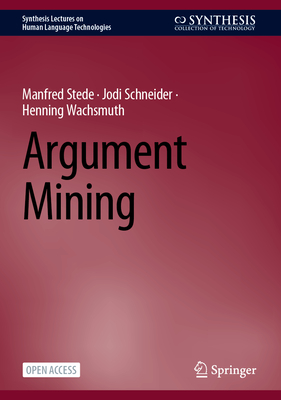
This Open Access book provides an essential overview of the topic of argumentation mining, an active research area of Natural Language Processing (NLP). Argument mining can automatically find and collect arguments published in newspapers, social media, or elsewhere. Argument mining can be also used to give a precise account of the argumentative structure of a single text or dialogue such as a legal or scientific document, a student essay, or an online conversation. Increasingly, computational approaches provide synopses of arguments and compare the relative strength of arguments. In this book, the authors start with basic argumentation concepts and describe the NLP methods for mining arguments automatically from natural language text. The authors then show how NLP is used for assessing the quality of arguments and generating new arguments. This Second Edition presents an updated survey of the state of the art of argument mining, providing increased depth and insights into many more NLP tasks than the prior edition. This new edition discusses the disruptive changes that have come with large language models and highlights potential future developments. The authors also update the treatment of the common steps in argument mining, argument generation tasks and methods, and computational argumentation applications. Completely new chapters cover perspective assessment, argument quality assessment, and argument reasoning.
商品描述(中文翻譯)
本開放取用書籍提供論證探勘(argumentation mining)的重要概述。論證探勘是自然語言處理(Natural Language Processing,NLP)領域中活躍的研究方向。論證探勘能夠自動找出並蒐集發表於報紙、社群媒體或其他地方的論證。它也可用來精確描述單一文本或對話中的論證結構,例如法律或科學文件、學生論文,或線上對話。
隨著計算方法日益發展,系統也能提供論證摘要,並比較不同論證的相對強度。在本書中,作者先從基本的論證概念出發,接著說明如何運用 NLP 方法,從自然語言文本中自動探勘論證。之後,作者將介紹 NLP 如何用於評估論證的品質,以及生成新的論證。
本第二版更新了論證探勘最新技術發展的概述,並比前一版更深入地探討更多 NLP 任務,提供更豐富的洞見。本新版也討論大型語言模型(large language models)所帶來的顛覆性變革,並強調可能的未來發展方向。作者同時更新了論證探勘常見步驟、論證生成任務與方法,以及計算論證應用等內容。
全新章節涵蓋觀點評估、論證品質評估,以及論證推理。
作者簡介
Jodi Schneider, Ph.D., is an Associate Professor of Information at the University of Wisconsin-Madison Information School, where she directs the Information Quality Lab. Dr. Schneider completed her Ph.D. in Informatics at the National University of Ireland, Galway. She studies the science of science through the lens of arguments, evidence, and persuasion. Her long-term goal is to ensure that public policy decisions can apply the best available scientific evidence. She is investigating knowledge representation approaches for bridging formal and informal argumentation, and her recent work analyzes the argumentative features of chatbots. Manfred Stede, Ph.D., is a Professor of Applied Computational Linguistics at the University of Potsdam, Germany. He completed his Ph.D. in Computer Science at the University of Toronto. He also studied Computer Science and Linguistics at TU Berlin and completed an M.Sc. in Computer Science at Purdue University. His research and teaching activities revolve around issues in discourse structure and automatic text understanding, and in the past 10 years has had a focus on discourse parsing and argument mining. Henning Wachsmuth, Ph.D., is a Professor of Natural Language Processing at the Institute of Artificial Intelligence of Leibniz University Hannover, Germany. He received his Ph.D. in Computer Science from Paderborn University. His group studies how intentions and views of people are reflected in language and how machines can understand and imitate this with large language models. Dr. Wachsmuth's main research interests include the computational assessment and generation of arguments, the mitigation of social bias and media bias, and the construction of human-like explanations for educational and explainable natural language processing.
作者簡介(中文翻譯)
Jodi Schneider 博士是威斯康辛大學麥迪遜分校資訊學院(University of Wisconsin-Madison Information School)的資訊學副教授,並主持 Information Quality Lab。Schneider 博士於愛爾蘭國立大學 Galway 分校取得資訊學博士學位。她透過論證、證據與說服的視角研究科學的科學(science of science)。她的長期目標是確保公共政策決策能夠運用現有的最佳科學證據。她目前正在研究如何透過知識表示方法銜接形式論證與非形式論證;近期的研究則分析聊天機器人的論證特徵。
Manfred Stede 博士是德國波茨坦大學(University of Potsdam)的應用計算語言學教授。他於多倫多大學(University of Toronto)取得電腦科學博士學位。此外,他也曾在柏林工業大學(TU Berlin)研習電腦科學與語言學,並於 Purdue University 取得電腦科學碩士學位。他的研究與教學活動主要圍繞篇章結構與自動文本理解等議題;過去 10 年來,研究重點則放在篇章解析(discourse parsing)與論證探勘(argument mining)。
Henning Wachsmuth 博士是德國萊布尼茲漢諾威大學(Leibniz University Hannover)人工智慧研究所的自然語言處理教授。他於帕德博恩大學(Paderborn University)取得電腦科學博士學位。他所帶領的研究團隊探討人們的意圖與觀點如何反映在語言中,以及機器如何透過大型語言模型理解並模仿這些內容。Wachsmuth 博士的主要研究興趣包括論證的計算評估與生成、社會偏見與媒體偏見的緩解,以及為教育用途與可解釋自然語言處理建構類人化的解釋。