Ai-Assisted Hardware Verification: Cognitive Verification Architecture with the Vega Framework
暫譯: AI 輔助硬體驗證:以 Vega Framework 建構的認知驗證架構
Kumar, Vikash
- 出版商: Springer
- 出版日期: 2026-10-12
- 售價: $5,140
- 貴賓價: 9.5 折 $4,883
- 語言: 英文
- 頁數: 166
- 裝訂: Hardcover - also called cloth, retail trade, or trade
- ISBN: 3032345456
- ISBN-13: 9783032345455
-
相關分類:
VLSI、Large language model
海外代購書籍(需單獨結帳)
相關主題


商品描述
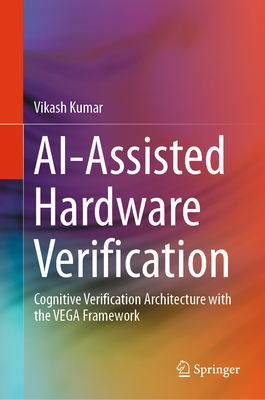
This book offers a structured methodology for applying generative AI to the functional verification of complex semiconductor designs, without sacrificing engineering accountability. It presents the VEGA framework--Verification Engineering through Guided AI--a complete verification lifecycle that treats AI as a governed accelerator, preserving traceability between design intent and verification evidence from specification through silicon sign-off.
Provides verification architects with a reliable framework to reduce pain of "ungoverned AI"
Describes prompts, templates, and quality gates, drawn from actual design verification challenges
Offers first comprehensive, methodologically grounded treatment of AI-assisted hardware verification
"VEGA arrives at exactly the right moment, when AI tools are powerful enough to transform verification productivity but undisciplined enough to undermine it. Vikash's intent-centric framework equips verification engineers, team leads, and architects to maintain quality and traceability from test plan through sign-off. A must-read for every hardware verification professional." -- Gaurav Jalan, Vice President, Engineering, Marvell
"AI is becoming part of verification, but using it without structure can create more risk than value. Vikash's VEGA framework gives engineers a practical way to apply AI while preserving design intent, traceability, review discipline, and human accountability. This is a timely and useful book for verification engineers, leads, and students looking to understand where AI-assisted verification is heading." -- Yunus Akhtar, Senior SoC Verification Engineer, Microsoft
"What stands out is the discipline. This isn't AI as a shortcut, it's AI as a governed accelerator, with verification quality made measurable rather than asserted and sign-off reframed as an evidence-based argument you can actually defend. Essential reading for any architect or lead bringing LLMs into a serious verification flow." -- Manish Tanwar, DV Architect, AMD
本書提供一套結構化方法,協助在不犧牲工程責任制的前提下,將生成式 AI 應用於複雜半導體設計的功能驗證。本書介紹 VEGA framework——Verification Engineering through Guided AI(透過引導式 AI 實現驗證工程)——這是一套完整的驗證生命週期方法,將 AI 視為受治理的加速器,從規格定義一路到晶片簽核,持續維持設計意圖與驗證證據之間的可追溯性。
為驗證架構師提供可靠的 framework,以減輕「未受治理的 AI」所帶來的困擾
說明源自實際設計驗證挑戰的 prompts、templates 與 quality gates
首次以完整且具方法論基礎的方式,深入探討 AI 輔助硬體驗證
「VEGA 在恰到好處的時機問世:AI 工具已強大到足以大幅提升驗證生產力,卻又缺乏足夠規範,可能反過來削弱驗證流程。Vikash 以意圖為核心的 framework,能協助驗證工程師、團隊主管與架構師,從測試計畫一路到簽核,都維持品質與可追溯性。這是每一位硬體驗證專業人士必讀的書。」——Gaurav Jalan,Marvell 工程副總裁
「AI 正逐漸成為驗證流程的一部分,但缺乏結構地使用 AI,所帶來的風險可能大於價值。Vikash 的 VEGA framework 為工程師提供實際可行的方法,在保留設計意圖、可追溯性、審查紀律與人員責任制的同時應用 AI。對於希望了解 AI 輔助驗證發展方向的驗證工程師、主管與學生而言,這是一本適時且實用的書。」——Yunus Akhtar,Microsoft 資深 SoC 驗證工程師
「最令人印象深刻的是其中的紀律性。這不是把 AI 當成捷徑,而是將 AI 視為受治理的加速器;驗證品質不再只是口頭宣稱,而是變得可衡量;簽核也重新被定義為一套真正能夠提出充分辯護、以證據為基礎的論證。對於任何要將 LLM 導入正式驗證流程的架構師或主管而言,這是不可或缺的讀物。」——Manish Tanwar,AMD DV 架構師
以上中文內容由 AI 翻譯作者簡介
Vikash Kumar is Senior Verification Architect at Arm with over 15 years of experience in the semiconductor industry, specializing in the design and verification of complex semiconductor systems across IP, subsystem, and full System-on-Chip (SoC) levels. His work focuses on large-scale SoC integration, functional correctness, debug, and verification closure for high-performance designs using Verilog, SystemVerilog, and UVM. Prior to joining Arm, Vikash held engineering roles at Aricent Technologies and Intel, where he contributed to several large-scale silicon programs including the Intel Data Streaming Accelerator and Intel Analytics Accelerator. He has extensive hands-on experience with industry-standard interconnect and chiplet protocols including AMBA (AXI), CHI5, PCIe, and UCIe and has worked deeply on integration-level verification where subtle cross-boundary assumptions can lead to late-stage silicon escapes. He holds a Bachelor of Technology in Electronics and Communication Engineering from West Bengal University of Technology (W.B.U.T.), Kolkata, India.
Vikash Kumar 是 Arm 的資深驗證架構師,在半導體產業擁有超過 15 年經驗,專精於 IP、子系統以及完整 System-on-Chip (SoC) 層級的複雜半導體系統設計與驗證。他的工作重點包括大型 SoC 整合、功能正確性、除錯,以及使用 Verilog、SystemVerilog 和 UVM,為高效能設計完成驗證收斂。
在加入 Arm 之前,Vikash 曾於 Aricent Technologies 和 Intel 擔任工程職務,參與多項大型矽晶片計畫,包括 Intel Data Streaming Accelerator 和 Intel Analytics Accelerator。他具備豐富的實務經驗,熟悉業界標準的互連與 chiplet 通訊協定,包括 AMBA (AXI)、CHI5、PCIe 和 UCIe;此外,他也深入從事整合層級驗證,因為跨邊界的細微假設可能導致問題延至後期流片階段才被發現。
他持有印度加爾各答 West Bengal University of Technology (W.B.U.T.) 電子與通信工程技術學士學位。
以上中文內容由 AI 翻譯