商品描述
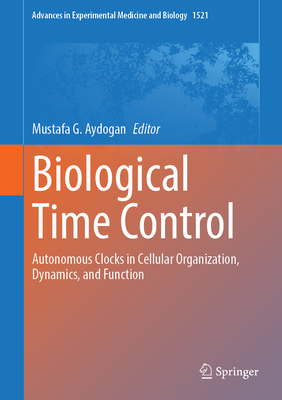
How do cells keep time? For decades, biological timekeeping has been understood through the lens of master clocks: the CDK-Cyclin oscillator that drives the cell division cycle and the circadian clock that aligns physiology with the day-night cycle. Yet recent discoveries are reshaping this view. Cellular time control is now emerging as a phenomenon governed not solely by such master clocks, but by coupled networks of otherwise independent timing mechanisms dedicated to specific cellular events. This book introduces and defines the emerging concept of autonomous clocks: cellular timing systems that can be entrained by canonical cell-cycle or circadian programs, yet retain the ability to operate independently to time and execute specific biological events. These autonomous clocks are increasingly recognized across organelle biogenesis, transcription, cytoskeletal remodeling, redox metabolism, proteostasis, immunity, nuclear organization, and even cytoplasmic division independent of nuclei and classical cell-cycle control. Together, they reveal a rich temporal architecture of the cell--one in which subcellular processes are not merely passive outputs of master clocks but are governed by dedicated oscillators that act as autonomous timing systems. Bringing together leading voices in cell biology, physiology, synthetic biology, biophysics, and mathematical biology, this volume offers the first comprehensive account of autonomous clocks as a unifying framework for biological time control. The chapters span foundational discoveries in autonomous transcriptional, cytoskeletal, redox, proteostasis, immune, and otherwise sub-cellular timing systems, while also exploring how these autonomous cycles couple to broader cellular rhythms, how they may be engineered synthetically, and how their principles can be understood through theory and computation. By synthesizing a decade of rapidly expanding discoveries, this book challenges long-standing textbook models of cellular timekeeping and opens new conceptual ground for understanding how cells coordinate physiology, maintain temporal order, and preserve function when canonical clocks are slowed, suspended, or silenced. Biological Time Control: Autonomous Clocks in Cellular Organization, Dynamics, and Function is an essential resource for students, researchers, and scholars interested in biological time control from the perspective of cell biology, systems biology, synthetic biology, physiology, and the molecular logic of cellular organization. It will be especially valuable to readers seeking a forward-looking framework for how timing mechanisms shape life at the subcellular, cellular, and organismal scales.
商品描述(中文翻譯)
細胞如何計時?數十年來,生物計時一直是透過主時鐘(master clocks)的觀點來理解:驅動細胞分裂週期的 CDK-Cyclin 振盪器,以及使生理活動與晝夜週期同步的生理時鐘。然而,近期的發現正在重新形塑這一觀點。如今,細胞時間控制逐漸被視為一種不僅由這類主時鐘所支配的現象,而是由彼此耦合、原本相互獨立,且各自負責特定細胞事件的多個計時機制網路所共同治理。
本書介紹並定義新興的「自主時鐘」(autonomous clocks)概念:這類細胞計時系統可以受到典型細胞週期或生理時鐘程式的牽引與同步,卻仍保有獨立運作的能力,能夠為特定生物事件計時並加以執行。人們日益發現,自主時鐘廣泛存在於胞器生成、轉錄、細胞骨架重塑、氧化還原代謝、蛋白質穩態、免疫、細胞核組織,以及甚至不依賴細胞核與經典細胞週期控制的細胞質分裂等過程中。這些發現共同揭示了細胞豐富的時間架構:在此架構中,次細胞過程並非只是主時鐘的被動輸出,而是由專責的振盪器所控制,這些振盪器本身即是自主的計時系統。
本書集結細胞生物學、生理學、合成生物學、生物物理學與數學生物學領域的頂尖學者,首次以完整的方式說明自主時鐘如何成為理解生物時間控制的統一框架。各章涵蓋自主轉錄、細胞骨架、氧化還原、蛋白質穩態、免疫及其他次細胞計時系統的基礎性發現,同時探討這些自主週期如何與更廣泛的細胞節律耦合、如何以合成方式加以工程化,以及如何透過理論與計算來理解其運作原理。本書整合了過去十年間迅速累積的大量研究成果,挑戰長久以來教科書對細胞計時的模型,並為理解細胞如何協調生理活動、維持時間秩序,以及在典型時鐘減速、暫停或沉默時仍維持功能,開拓嶄新的概念視野。
《生物時間控制:細胞組織、動態與功能中的自主時鐘》(Biological Time Control: Autonomous Clocks in Cellular Organization, Dynamics, and Function)是對生物時間控制感興趣的學生、研究人員與學者不可或缺的參考資源,涵蓋細胞生物學、系統生物學、合成生物學、生理學,以及細胞組織之分子邏輯等觀點。對於希望以具前瞻性的架構理解計時機制如何在次細胞、細胞及生物體尺度上形塑生命的讀者而言,本書尤其具有價值。
作者簡介
Dr. Mustafa Aydogan is an Assistant Professor of Genetics and Development at Columbia University and an Early Career Scholar of the Howard Hughes Medical Institute. He received his B.A. in Molecular, Cellular, and Developmental Biology from the University of Colorado Boulder, where he worked under the mentorship of J. Richard McIntosh and Natalie G. Ahn. During his doctoral studies with Jordan Raff at the University of Oxford, Dr. Aydogan discovered the molecular clock that drives centriole biogenesis cycles: one that is normally entrained by the canonical cell-cycle oscillator, CDK-cyclin complexes, to remain synchronized with the cycles of DNA replication and segregation, yet it can also operate independently to govern centriole biogenesis when CDK activity is silenced. Together with other studies revealing a broad range of cell biological processes regulated by autonomous cycles, Dr. Aydogan's foundational contributions and leadership have helped define the emerging concept of autonomous clocks. His pioneering work enabled him to launch his independent laboratory immediately after his Ph.D. as a Faculty Fellow at the University of California, San Francisco. Dr. Aydogan's recent work continues to shape this field, including his laboratory's discovery that cytokinesis, the division of the cytoplasm, can proceed in periodic cycles independently of the nucleus and mitotic CDK-cyclin complexes. His early accomplishments have been recognized by numerous honors, including the Sandler Foundation Faculty Award in 2020, the NIH Director's New Innovator Award in 2023, and the HHMI Freeman Hrabowski Scholar Award in 2025.
作者簡介(中文翻譯)
Mustafa Aydogan 博士是 Columbia University 的遺傳學與發育學助理教授,也是 Howard Hughes Medical Institute 的早期職涯學者。他於 University of Colorado Boulder 取得分子、細胞與發育生物學學士學位,期間師從 J. Richard McIntosh 與 Natalie G. Ahn。博士期間,Aydogan 博士在 University of Oxford 跟隨 Jordan Raff 進行研究,發現驅動中心粒(centriole)生合成週期的分子時鐘:這套時鐘通常會受到典型細胞週期振盪器——CDK-cyclin 複合體——的同步調節,使其與 DNA 複製及分離的週期保持同步;然而,即使 CDK 活性遭到沉默,它也能獨立運作,調控中心粒的生合成。
除了其他研究揭示各種由自主性週期所調控的廣泛細胞生物學過程之外,Aydogan 博士的奠基性貢獻與領導力,也協助定義了新興的「自主性時鐘」(autonomous clocks)概念。他的開創性研究使他得以在取得博士學位後,立即以 Faculty Fellow 身分於 University of California, San Francisco 創立自己的獨立實驗室。Aydogan 博士近期的研究持續形塑這個領域;其中包括其實驗室發現,細胞質分裂(cytokinesis)能夠在不依賴細胞核與有絲分裂 CDK-cyclin 複合體的情況下,以週期性循環進行。
他的早期成就獲得多項榮譽肯定,包括 2020 年 Sandler Foundation Faculty Award、2023 年 NIH Director's New Innovator Award,以及 2025 年 HHMI Freeman Hrabowski Scholar Award。