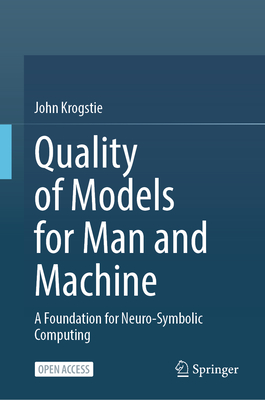
Quality of Models for Man and Machine: A Foundation for Neuro-Symbolic Computing
暫譯: 人類與機器的模型品質:神經符號運算的基礎
Krogstie, John
- 出版商: Springer
- 出版日期: 2026-11-01
- 售價: $2,710
- 貴賓價: 9.5 折 $2,574
- 語言: 英文
- 頁數: 323
- 裝訂: Hardcover - also called cloth, retail trade, or trade
- ISBN: 3032421284
- ISBN-13: 9783032421289
-
相關分類:
Machine Learning
海外代購書籍(需單獨結帳)
相關主題

商品描述
This open access book investigates the renewed role of models in the solutions supporting our organisational reality. With AI and other advanced IT as digital actors, we are more and more delegating decisions that help to create new social reality to autonomous artificial systems. This raises several critical questions, for example, how can we keep our skills in building and discussing abstractions to create a unified view of the existing and emerging social and digital reality? How can we build autonomous information systems using these abstractions that we understand and trust, i.e., systems that reflect our values, and that are semantically transparent and able to explain their decisions? In recent years, the main focus on AI has been machine learning and generative AI with limited explainability. In the future, AI will combine traditional symbolic techniques (including conceptual modelling and knowledge graphs) with sub-symbolic techniques (neural networks) in neuro-symbolic computing. Supporting modelling of the people, by the people, for the people becomes, in this situation, necessary to empower humans to stay as active actors in the loop of AI-enhanced decision-making and action. To understand how work in neuro-symbolic computing can progress, we should clarify what it means for both the symbolic and machine learning models to be good. What is the quality of the different types of models, and how do these notions of quality align with human notions of quality? The quality of conceptual models (as an example of symbolic models) has been investigated for many decades. In this book, we will combine works from semiotics, information systems, conceptual modelling, AI and neuroscience to investigate the quality of models and data for both human and machine actors, laying a firm foundation for the future converging neuro-symbolic computing.
商品描述(中文翻譯)
本開放取用書籍探討模型在支援組織現實的解決方案中所重新扮演的角色。隨著 AI 與其他先進 IT 成為數位行動者,我們正日益將有助於建構新社會現實的決策,委由自主人工系統代為執行。這引發了數個關鍵問題,例如:我們要如何維持建構與討論抽象概念的能力,以形成對既有及新興社會與數位現實的統一觀點?我們要如何運用這些我們理解且信任的抽象概念,建構自主資訊系統;也就是建構能反映我們價值觀、具備語意透明度,並且能解釋其決策的系統?
近年來,AI 的主要焦點一直放在機器學習與可解釋性有限的生成式 AI。未來,AI 將在神經符號運算(neuro-symbolic computing)中,結合傳統的符號技術(包括概念建模與知識圖譜)以及次符號技術(神經網路)。在這種情況下,支援「由人建模、為人建模、由人使用」將成為必要條件,使人類能夠持續作為 AI 強化之決策與行動迴圈中的主動行動者。
為了理解神經符號運算的研究工作如何持續發展,我們應釐清對符號模型與機器學習模型而言,什麼才算是好的模型。不同類型模型的品質為何?這些品質概念又如何與人類對品質的理解相互契合?概念模型的品質(作為符號模型的一個例子)已經歷數十年的研究。在本書中,我們將結合符號學、資訊系統、概念建模、AI 與神經科學等領域的研究,探討模型與資料對人類行動者及機器行動者而言的品質,為未來逐漸融合的神經符號運算奠定穩固基礎。
作者簡介
John Krogstie holds a PhD (1995) and a MSc (1991) in information systems from the Norwegian University of Science and Technology (NTNU), where he is currently a full professor in information systems at the computer science department (IDI). John Krogstie is the Norwegian representative and previously Vice-Chair for IFIP TC8 and was chair of IFIP WG 8.1 on information system design and evaluations (2010-2015). His research interests are information systems development, information systems engineering, quality of models and modelling languages, neuro-conceptualization, eGovernment, sustainable smart cities and sustainable digitalization in general. He has published more than 380 refereed papers in journals, books and archival proceedings since 1991.
作者簡介(中文翻譯)
John Krogstie 於 1995 年取得博士學位,並於 1991 年取得資訊系統碩士學位,兩者皆來自挪威科技大學(Norwegian University of Science and Technology,NTNU)。目前,他在該校資訊工程系(Department of Computer Science,IDI)擔任資訊系統學領域的正教授。
John Krogstie 是 IFIP TC8 的挪威代表,過去曾擔任副主席;此外,他也曾於 2010 至 2015 年擔任 IFIP WG 8.1(資訊系統設計與評估)的主席。他的研究興趣包括資訊系統開發、資訊系統工程、模型與建模語言的品質、神經概念化(neuro-conceptualization)、電子化政府(eGovernment)、永續智慧城市,以及整體性的永續數位化。
自 1991 年起,他已在期刊、書籍及正式論文集(archival proceedings)中發表超過 380 篇經同儕審查的論文。