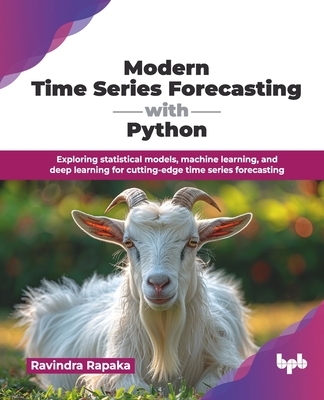
Modern Time Series Forecasting with Python: Exploring statistical models, machine learning, and deep learning for cutting-edge time series forecasting
暫譯: 使用 Python 進行現代時間序列預測:探索統計模型、機器學習和深度學習的前沿時間序列預測技術
Rapaka, Ravindra
- 出版商: BPB Publications
- 出版日期: 2026-03-09
- 售價: $1,640
- 貴賓價: 9.5 折 $1,558
- 語言: 英文
- 頁數: 446
- 裝訂: Quality Paper - also called trade paper
- ISBN: 9365893623
- ISBN-13: 9789365893625
-
相關分類:
Python、Machine Learning
海外代購書籍(需單獨結帳)
相關主題
商品描述
Time series forecasting is driving decision-making in everything from financial markets to supply chain logistics. This book provides a hands-on roadmap to mastering this technology, bridging the gap between classical statistical rigor and cutting-edge artificial intelligence.
Understand time series fundamentals by exploring decomposition, stationarity, and ACF/PACF analysis before mastering preprocessing and feature engineering. You will build foundational ARIMA, SARIMA, and Holt-Winters' models before pivoting to machine learning with XGBoost and Scikit-learn. The journey accelerates into deep learning, designing RNNs, LSTMs, and hybrid CNN-LSTM architectures for univariate and multivariate forecasting. After exploring advanced VAR and VECM models, you will implement walk-forward validation and professional error metrics. The final sections cover scalability and MLOps, teaching you to handle big data with Dask and deploy production-ready models via FastAPI and Apache Kafka.
By the end of this book, you will be a competent practitioner capable of building high-performance forecasting pipelines for stock prices, demand, and sensor data. You will possess the technical expertise to deploy scalable, ethical, and accurate models in real-world cloud environments with confidence.
What you will learn
● Diagnose trend and seasonality using Statsmodels stationarity.
● Build ARIMA/SARIMA and smoothing models using Statsmodels.
● Engineer lag, rolling, and calendar-based forecasting features.
● Deploy FastAPI pipelines and monitor Kafka drift.
● Build LSTM and GRU architectures with TensorFlow.
● Backtest, compare, and ensemble models with confidence.
● Deploy, monitor, and retrain forecasting pipelines at scale.
Who this book is for
This book is designed for data scientists, machine learning engineers, and analysts mastering temporal data. Proficiency in Python and basic statistics is required, while experience with cloud deployment or deep learning helps professional engineers scale models using the featured technical frameworks.
Table of Contents
1. Introduction to Time Series Data and Analysis
2. Data Pre-processing and Feature Engineering
3. Exploratory and Statistical Analysis of Time Series
4. Autoregressive Models
5. Moving Average and ARMA Models
6. ARIMA and SARIMA Models
7. Exponential Smoothing Methods
8. Feature-based Machine Learning for Time Series Forecasting
9. Introduction to Deep Learning for Time Series
10. Building and Training LSTM Models for Time Series
11. Advanced Deep Learning Architectures and Multivariate Forecasting
12. Multivariate Time Series Forecasting
13. Model Evaluation, Selection, and Ensembling
14. Forecasting at Scale and Model Deployment
15. Time Series Forecasting in Practice
商品描述(中文翻譯)
時間序列預測正在推動從金融市場到供應鏈物流的決策制定。本書提供了一個實用的路線圖,幫助讀者掌握這項技術,彌合傳統統計嚴謹性與尖端人工智慧之間的鴻溝。
通過探索分解、平穩性以及自相關函數(ACF)/偏自相關函數(PACF)分析來理解時間序列的基本概念,然後掌握預處理和特徵工程。您將建立基礎的自回歸整合移動平均(ARIMA)、季節性自回歸整合移動平均(SARIMA)和霍爾特-溫特斯模型,然後轉向使用 XGBoost 和 Scikit-learn 的機器學習。接下來的旅程將加速進入深度學習,設計循環神經網絡(RNN)、長短期記憶(LSTM)和混合卷積神經網絡-長短期記憶(CNN-LSTM)架構,以進行單變量和多變量預測。在探索高級向量自回歸(VAR)和向量誤差修正模型(VECM)之後,您將實施前向驗證和專業的誤差指標。最後幾個部分涵蓋可擴展性和 MLOps,教您如何使用 Dask 處理大數據,並通過 FastAPI 和 Apache Kafka 部署生產就緒的模型。
在本書結束時,您將成為一名能夠為股票價格、需求和傳感器數據構建高性能預測管道的合格從業者。您將擁有在現實世界的雲環境中自信地部署可擴展、道德且準確模型的技術專業知識。
您將學到的內容:
- 使用 Statsmodels 的平穩性診斷趨勢和季節性。
- 使用 Statsmodels 構建 ARIMA/SARIMA 和平滑模型。
- 工程化滯後、滾動和基於日曆的預測特徵。
- 部署 FastAPI 管道並監控 Kafka 漂移。
- 使用 TensorFlow 構建 LSTM 和 GRU 架構。
- 自信地回測、比較和集成模型。
- 在大規模下部署、監控和重新訓練預測管道。
本書的讀者對象:
本書專為數據科學家、機器學習工程師和分析師設計,旨在掌握時間數據。需要具備 Python 和基本統計的熟練度,而雲部署或深度學習的經驗將幫助專業工程師使用所介紹的技術框架擴展模型。
目錄:
1. 時間序列數據與分析簡介
2. 數據預處理與特徵工程
3. 時間序列的探索性和統計分析
4. 自回歸模型
5. 移動平均和 ARMA 模型
6. ARIMA 和 SARIMA 模型
7. 指數平滑方法
8. 基於特徵的時間序列預測機器學習
9. 時間序列的深度學習簡介
10. 為時間序列構建和訓練 LSTM 模型
11. 高級深度學習架構和多變量預測
12. 多變量時間序列預測
13. 模型評估、選擇和集成
14. 大規模預測和模型部署
15. 實踐中的時間序列預測