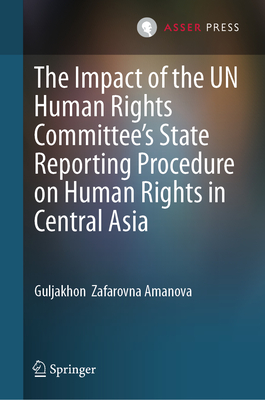
This book examines how a mandatory UN oversight mechanism can influence State behaviour and legal reform in one of the world's least studied regions. It reveals that the Human Rights Committee's (hereafter: HRCtee) State reporting procedure is far more than a formal obligation: it operates as a sustained process of dialogue, persuasion, and normative pressure. By following the reporting cycles from the late Soviet era through the post-independence submissions of Kazakhstan, Kyrgyzstan, Tajikistan, Turkmenistan, and Uzbekistan over nearly five decades, the monograph uncovers how the process has shaped domestic debate, made room for civil society engagement, and contributed to legislative and institutional change. Drawing on a combination of field research, documentary evidence, interviews with government officials, civil society activists and experts, as well as direct observation of HRCtee sessions, the book highlights both the visible -- such as references to the Committee's interpretation in legal acts -- and more subtle forms of influence, including gradual shifts in discourse, expectations, and administrative practice. What distinguishes this book is its exclusive focus on the reporting mechanism itself, rather than the more frequently analysed individual complaints procedure. It shows how structured dialogue, interpretative guidance, and reputational incentives can lead to the gradual internalisation of norms, even in contexts marked by political sensitivity, limited transparency, and post-Soviet bureaucratic legacies. Spanning the USSR's ratification of the ICCPR in 1973 to the contemporary engagement of the Central Asian states with the UN treaty body system, the volume traces a narrative of resistance, adaptation, and institutional learning. The book is intended for scholars, experts, practitioners, and policy actors interested in how international oversight influences domestic change, and offers practical insights for those seeking to engage with treaty bodies, strengthen domestic reforms, or assess the real-world effects of international human rights monitoring.
Guljakhon Zafarovna Amanova holds a PhD in legal studies from the University of Cambridge, and is an independent human rights legal researcher focusing on Uzbekistan and Central Asia, based in Tashkent, Uzbekistan.
本書探討了強制性聯合國監督機制如何影響國家行為和法律改革,特別是在全球最少研究的地區之一。它揭示了人權委員會(以下簡稱:HRCtee)的國家報告程序遠不僅僅是一項形式上的義務:它作為一個持續的對話、說服和規範壓力的過程運作。
通過追蹤從蘇聯末期到哈薩克、吉爾吉斯、塔吉克、土庫曼和烏茲別克在獨立後近五十年的報告周期,這本專著揭示了該過程如何塑造國內辯論,為公民社會參與創造空間,並促進立法和制度變革。該書結合了實地研究、文獻證據、與政府官員、公民社會活動家和專家的訪談,以及對HRCtee會議的直接觀察,突顯了可見的影響(例如法律行為中對委員會解釋的引用)和更微妙的影響形式,包括話語、期望和行政實踐的逐步變化。
本書的特點在於其專注於報告機制本身,而非更常被分析的個別申訴程序。它展示了結構化對話、解釋性指導和聲譽激勵如何導致規範的逐步內化,即使在政治敏感性、透明度有限和後蘇聯官僚遺產的背景下也是如此。從蘇聯於1973年批准《公民及政治權利國際公約》(ICCPR)到當前中亞國家與聯合國條約機構系統的互動,本書描繪了一個抵抗、適應和制度學習的敘事。
本書旨在為學者、專家、實務工作者和政策參與者提供有關國際監督如何影響國內變革的見解,並為那些希望與條約機構互動、加強國內改革或評估國際人權監測的實際影響的人士提供實用的見解。
古爾賈洪·扎法羅夫娜·阿馬諾娃擁有劍橋大學的法律研究博士學位,是一位獨立的人權法律研究者,專注於烏茲別克和中亞,常駐於烏茲別克的塔什干。