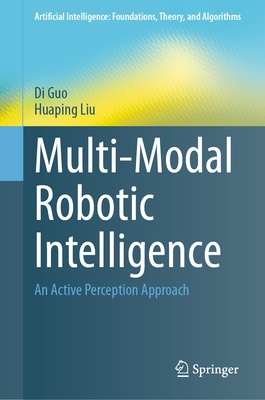
Recently, substantial progress has been made in the machine perception, particularly computer vision, largely due to the advancements in deep learning techniques. However, robots often operate in unstructured environments, which differ greatly from the well-defined problems typically addressed in computer vision. Consequently, many existing computer vision solutions are not directly applicable to robotics. Additionally, modern intelligent robots have access to multi-modal sensory information, rather than relying on a single modality. Therefore, it is essential to explore the specific challenges of multi-modal robotic intelligence. A key requirement for all intelligent robots is the capability of active perception. Active perception is an effective approach to bridge the gap between robotics and machine perception. Intelligence emerges when the robot actively interacts with the environment, embodying a close coupling of perception and action within a continuous feedback loop. Perception guided action, and each movement generate information that informs subsequent movements. With a variety of available multi-modal sensory information, it is crucial for robots to leverage active perception techniques to achieve multi-modal robotic intelligence. This book introduces multi-modal robotic intelligence from the perspective of active perception. Extensive robotic multi-modal active perception problems are formulated and corresponding case studies are described. Specifically, this book is organized in three parts. Part I covers core concepts and approaches for multi-modal robotic intelligence. In Part II, active perception for robotic intelligence is described, which presents several typical active perception tasks. Part III further describes the multi-modal active perception for robotic intelligence. The book is primarily intended for researchers and graduates with a foundational knowledge of machine learning, spanning in a wide range of disciplines, particularly those involved in robotic intelligence and sensor fusion.
最近,在機器感知,特別是計算機視覺方面取得了顯著進展,這主要歸功於深度學習技術的進步。然而,機器人通常在非結構化的環境中運作,這些環境與計算機視覺中通常處理的明確問題有很大不同。因此,許多現有的計算機視覺解決方案並不直接適用於機器人。此外,現代智能機器人可以訪問多模態的感知信息,而不是僅依賴單一模態。因此,探索多模態機器智能的具體挑戰是至關重要的。
所有智能機器人的一個關鍵要求是具備主動感知的能力。主動感知是一種有效的方法,可以彌合機器人技術與機器感知之間的差距。當機器人主動與環境互動時,智能便會出現,這體現了感知與行動之間的緊密耦合,並形成一個持續的反饋循環。感知引導行動,每一次移動都會產生信息,這些信息會影響後續的動作。隨著各種可用的多模態感知信息,機器人利用主動感知技術來實現多模態機器智能是至關重要的。
本書從主動感知的角度介紹多模態機器智能。廣泛的機器人多模態主動感知問題被提出,並描述了相應的案例研究。具體而言,本書分為三個部分。第一部分涵蓋多模態機器智能的核心概念和方法。第二部分描述了機器智能的主動感知,介紹了幾個典型的主動感知任務。第三部分進一步描述了機器智能的多模態主動感知。本書主要面向具有機器學習基礎知識的研究人員和研究生,涵蓋廣泛的學科,特別是那些涉及機器智能和感測器融合的領域。
以上中文內容由 AI 翻譯