商品描述
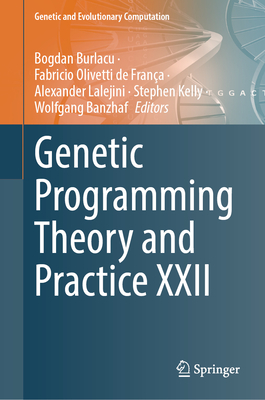
Genetic Programming Theory and Practice brings together some of the most impactful researchers in the field of genetic programming (GP), each one working on unique and interesting intersections of theoretical development and practical applications of this evolutionary-based machine learning paradigm. Topics of particular interest for this year's volume include powerful modeling techniques through GP-based symbolic regression, novel selection mechanisms that help guide the evolutionary process, modular approaches to GP, and applications in cybersecurity, biomedicine and program synthesis, as well as papers by practitioner of GP that focus on usability and real-world results. In summary, readers will get a glimpse of the current state-of-the-art in GP research.
商品描述(中文翻譯)
《遺傳程式設計理論與實務》匯集了遺傳程式設計(GP)領域中一些最具影響力的研究者,每位研究者都在理論發展與實際應用的獨特且有趣的交集上進行工作。今年卷中特別關注的主題包括透過基於GP的符號回歸進行強大的建模技術、幫助指導進化過程的新選擇機制、模組化的GP方法,以及在網路安全、生物醫學和程式合成中的應用,還有專注於可用性和實際結果的GP實務者的論文。總之,讀者將能窺見GP研究的最新前沿狀態。
作者簡介
Bogdan Burlacu is a lecturer of computer science at the Gheorghe Asachi Technical University of Iași, Romania. He specializes in machine learning and symbolic regression, focusing on genetic programming evolutionary dynamics, and is co-author of the book "Symbolic Regression". His research focuses on developing and refining methods that extract meaningful mathematical models directly from data, contributing to advances in both the theoretical foundations and practical applications of symbolic regression. He is also the author of the Operon symbolic regression library. Fabrício Olivetti de França is a professor of computer science at the Federal University of ABC, current head of the Heuristics, Analysis and Learning Laboratory (HAL) and the coordinator of the graduate program of computer science at the same university. His work in symbolic regression comprehends the creation of new techniques promoting interpretability and the integration of domain knowledge. He is also one of the main contributors of SRBench having helped to host multiple competitions for symbolic regression and the current version of SRBench. He co-organized Symbolic Regression workshops at GECCO for the past years together with Gabriel Kronberger and William La Cava. He is also part of the organization of the Genetic Programming Theory and Practice workshop. Alexander Lalejini is an assistant professor in the Department of Computer Science at Grand Valley State University and holds a dual PhD in Computer Science and Ecology, Evolution, and Behavior from Michigan State University. His research intersects computer science and evolution, applying the principles of each field to advance the other. Broadly, his work focuses on (1) developing digital systems to investigate fundamental questions about how evolution works, (2) harnessing our understanding of evolution to engineer new algorithms to solve challenging computational problems, and (3) facilitating knowledge transfer between the fields of evolutionary biology and evolutionary computing. Stephen Kelly is an artist and assistant professor in the Department of Computing and Software at McMaster University. His computer science research investigates how emergent forms of memory and hierarchy allow digital evolution to build algorithms in dynamic, partially-observable, and multi-task temporal sequence prediction environments. His research-creation works are mechatronic art/science hybrids which use nature-inspired computing as raw material for storytelling, activism, and public engagement. He received his PhD in computer science from Dalhousie University, BFA from the Nova Scotia College of Art and Design, and completed an NSERC post-doctoral fellowship at the BEACON Center for the study of Evolution in Action at Michigan State University. Wolfgang Banzhaf is the John R. Koza Chair for Genetic Programming in the Department of Computer Science and Engineering at Michigan State University. He received his Dr.rer.nat (PhD) from the Department of Physics of the Technische Hochschule Karlsruhe, now Karlsruhe Institute of Technology (KIT). His research interests are evolutionary computing, complex adaptive systems, and self-organization of artificial life. He is a member of the Advisory Committee of ACM-SIGEVO, the Special Interest Group for Evolutionary Computation of the Association of Computing Machinery and has served as its Chair from 2011 to 2015 after having served as SIGEVO's treasurer 2005-2011. From its foundation, he was member of the Executive Board of SIGEVO from 2005 to 2021, and of the International Society for Artificial Life (ISAL) from 2009 to 2015, and from 2019 to today. He has founded the scholarly journal "Genetic Programming and Evolvable Machines".
作者簡介(中文翻譯)
Bogdan Burlacu 是羅馬尼亞雅西的 Gheorghe Asachi 技術大學計算機科學講師。他專注於機器學習和符號回歸,特別是基因編程的演化動力學,並且是書籍《Symbolic Regression》的共同作者。他的研究重點在於開發和完善從數據中直接提取有意義的數學模型的方法,為符號回歸的理論基礎和實際應用的進展做出貢獻。他也是 Operon 符號回歸庫的作者。
Fabrício Olivetti de França 是巴西聯邦大學計算機科學教授,目前擔任啟發式、分析與學習實驗室(HAL)的負責人,以及該大學計算機科學研究生課程的協調員。他在符號回歸方面的工作包括創建促進可解釋性和整合領域知識的新技術。他也是 SRBench 的主要貢獻者之一,幫助舉辦多次符號回歸競賽及當前版本的 SRBench。他與 Gabriel Kronberger 和 William La Cava 共同組織了過去幾年的 GECCO 符號回歸研討會。他也是基因編程理論與實踐研討會的組織成員。
Alexander Lalejini 是大峽谷州立大學計算機科學系的助理教授,並擁有密西根州立大學計算機科學及生態學、演化與行為的雙博士學位。他的研究交叉於計算機科學和演化,應用每個領域的原則來推進另一個領域。廣義上,他的工作集中於 (1) 開發數位系統以探討演化運作的基本問題,(2) 利用我們對演化的理解來設計新算法以解決挑戰性的計算問題,以及 (3) 促進演化生物學與演化計算領域之間的知識轉移。
Stephen Kelly 是麥克馬斯特大學計算與軟體系的藝術家及助理教授。他的計算機科學研究探討如何新興的記憶和層級形式使數位演化能夠在動態、部分可觀察和多任務的時間序列預測環境中構建算法。他的研究創作作品是機電藝術/科學的混合體,利用自然啟發的計算作為講故事、行動主義和公共參與的原材料。他在達爾豪斯大學獲得計算機科學博士學位,在新斯科舍藝術與設計學院獲得美術學士學位,並在密西根州立大學的 BEACON 演化研究中心完成了 NSERC 博士後研究獎學金。
Wolfgang Banzhaf 是密西根州立大學計算機科學與工程系的 John R. Koza 基因編程講座教授。他在卡爾斯魯厄理工學院(Technische Hochschule Karlsruhe,現為 Karlsruhe Institute of Technology,KIT)的物理系獲得 Dr.rer.nat(博士學位)。他的研究興趣包括演化計算、複雜適應系統和人工生命的自我組織。他是 ACM-SIGEVO 的諮詢委員會成員,該組織是計算機協會的演化計算特別興趣小組,並於 2011 年至 2015 年擔任其主席,之前擔任 SIGEVO 的財務主管(2005-2011)。自成立以來,他於 2005 年至 2021 年擔任 SIGEVO 執行委員會成員,並於 2009 年至 2015 年及 2019 年至今擔任國際人工生命學會(ISAL)成員。他創立了學術期刊《Genetic Programming and Evolvable Machines》。