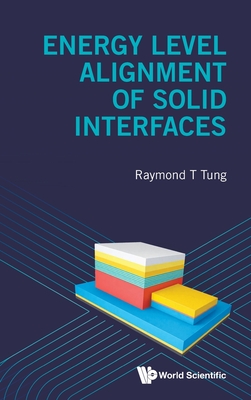
Energy Level Alignment of Solid Interfaces
暫譯: 固體介面能量水平對齊
Tung Raymond T
- 出版商: World Scientific Pub
- 出版日期: 2026-04-15
- 售價: $4,560
- 貴賓價: 9.5 折 $4,332
- 語言: 英文
- 頁數: 298
- 裝訂: Hardcover - also called cloth, retail trade, or trade
- ISBN: 9819825741
- ISBN-13: 9789819825745
-
相關分類:
材料科學 Meterials
海外代購書籍(需單獨結帳)
相關主題


商品描述
This book, Energy Level Alignment of Solid Interfaces, focuses on the Schottky barrier height (SBH) of metal-semiconductor interfaces and the band offset (BO) of semiconductor heterojunction interfaces, which are crucial to the performance of advanced solid-state devices and have been extensively investigated for decades. These interface parameters are direct results of interface charge distribution and should be explained on that basis. For a long time, however, such a scientifically grounded approach was not possible, and the explanation of SBH and BO largely relied on empirical models.
Several breakthroughs in recent years have finally provided a scientific explanation of these band-alignment conditions through charge distribution. To achieve this, the long tradition of employing surface quantities to represent solid crystals-dating back to the time of Schottky and Mott and followed by researchers ever since-was abandoned. Instead, model solids without surface dipoles were adopted as the proper representatives of solid crystals.
This book discusses these recent developments, beginning with a semiclassical host-bath approach to analyse all energy-level-alignment problems. It also explains in detail how the nearsightedness principle is used to construct model solids through neutral polyhedra theory (NPT), and how SBH and BO can be quantitatively modelled using bulk crystal charge density. The wide success of this density-based approach in explaining and predicting BO at covalent, ionic, and polycrystalline heterojunction interfaces, as well as SBH at epitaxial and polycrystalline metal-semiconductor interfaces, is examined.
The phenomenon of Fermi-level pinning, which dominated the SBH and BO field and puzzled researchers for decades, is likewise shown to have a simple explanation based on charge distribution, once the important issues of the metallicity boundary and SBH inhomogeneity are properly recognised.
商品描述(中文翻譯)
這本書《固體介面的能量水平對齊》專注於金屬-半導體介面的肖特基障礙高度(SBH)和半導體異質接面介面的能帶偏移(BO),這些參數對於先進固態設備的性能至關重要,並且已被廣泛研究了幾十年。這些介面參數是介面電荷分佈的直接結果,應該基於此進行解釋。然而,長期以來,這種科學基礎的方法並不可行,SBH和BO的解釋主要依賴於經驗模型。
近幾年來的幾項突破最終通過電荷分佈提供了這些能帶對齊條件的科學解釋。為了實現這一點,放棄了長期以來使用表面量來表示固體晶體的傳統——這一傳統可以追溯到肖特基和莫特的時代,並且自那時以來一直被研究人員沿用。相反,採用了沒有表面偶極的模型固體作為固體晶體的適當代表。
本書討論了這些近期的發展,首先以半經典的主體-浴槽方法分析所有能量水平對齊問題。它還詳細解釋了如何利用近視原則通過中性多面體理論(NPT)構建模型固體,以及如何使用體晶體電荷密度對SBH和BO進行定量建模。本書檢視了這種基於密度的方法在解釋和預測共價、離子和多晶異質接面上的BO,以及在外延和多晶金屬-半導體介面上的SBH方面的廣泛成功。
主導SBH和BO領域並使研究人員困惑數十年的費米能級固定現象,同樣基於電荷分佈有一個簡單的解釋,前提是正確認識金屬性邊界和SBH不均勻性等重要問題。