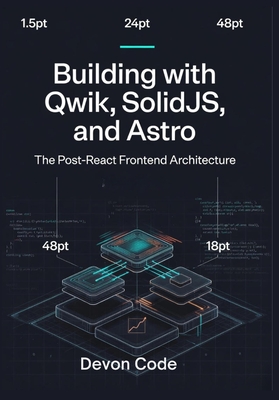
Building with Qwik, SolidJS, and Astro: The Post-React Frontend Architecture
暫譯: 使用 Qwik、SolidJS 和 Astro 建構:後 React 前端架構
Code, Devon
- 出版商: Independently Published
- 出版日期: 2025-12-13
- 售價: $1,150
- 貴賓價: 9.5 折 $1,092
- 語言: 英文
- 頁數: 180
- 裝訂: Quality Paper - also called trade paper
- ISBN: 9798278603818
- ISBN-13: 9798278603818
-
相關分類:
JavaScript
無法訂購
相關主題

商品描述
Senior engineers face unprecedented pressure to build applications that load in milliseconds across devices, from high-end workstations to budget smartphones. JavaScript fatigue has morphed from developer inconvenience into measurable business impact, affecting conversion rates, SEO rankings, and infrastructure costs. With Core Web Vitals directly influencing search rankings and user expectations reaching new heights, performance is no longer optional-it is existential. This guide addresses that reality with concrete code, architectural patterns, and production-tested strategies from teams who have successfully made the transition.
You will learn to: - Implement Qwik's resumability pattern to eliminate hydration costs entirely, reducing initial JavaScript payloads to mere kilobytes while preserving complex application state across server boundaries - Construct reactive UIs with SolidJS that demonstrate benchmark performance exceeding virtual DOM alternatives by 10-100x, with compilation output often beating hand-written vanilla JavaScript in real-world scenarios - Architect Astro projects using island-based hydration, shipping zero JavaScript by default while preserving full interactivity exactly where users need it most - Analyze production metrics comparing memory usage, CPU cycles, and time-to-interactive across framework generations with statistical rigor and repeatable testing methodologies - Execute incremental migration strategies from React without committing to expensive full-rewrites or disrupting product roadmaps that demand continuous delivery - Configure edge deployments that deliver consistent sub-50ms response times globally, turning performance into competitive advantage while reducing infrastructure spend
Beyond framework APIs, this book examines the architectural principles that make these performance gains possible. Each concept connects to measurable outcomes, helping you justify technical decisions to stakeholders and team members who control budgets and timelines. The goal is not mere theoretical understanding but practical authority to lead your organization forward.
The frontend landscape rewards early adoption of proven performance strategies. This book equips you with the knowledge to evaluate, implement, and lead with Qwik, SolidJS, and Astro.
商品描述(中文翻譯)
如果您的網頁應用程式能在中階手機上實現即時互動,同時使您的程式碼庫更易於維護,會怎樣呢? 接受 React 固有限制的時代——臃腫的包、緩慢的水合和不斷增加的運行時開銷——即將結束。本書提供了一個以性能為首的檢視,探討三個在 2025 年重寫前端規則的框架。
資深工程師面臨前所未有的壓力,必須構建能在毫秒內加載的應用程式,無論是高端工作站還是預算型智能手機。JavaScript 疲勞已從開發者的不便轉變為可衡量的商業影響,影響轉換率、SEO 排名和基礎設施成本。隨著 Core Web Vitals 直接影響搜索排名,並且用戶期望達到新高度,性能不再是可選的——而是生死攸關的。本指南通過具體的代碼、架構模式和來自成功轉型團隊的生產測試策略來應對這一現實。
您將學會: - 實現 Qwik 的可恢復性模式,完全消除水合成本,將初始 JavaScript 負載減少到僅幾 KB,同時在伺服器邊界之間保留複雜的應用狀態 - 使用 SolidJS 構建反應式 UI,展示超越虛擬 DOM 替代品 10-100 倍的基準性能,編譯輸出在現實場景中經常超越手寫的原生 JavaScript - 使用基於島嶼的水合架構 Astro 專案,預設不發送任何 JavaScript,同時在用戶最需要的地方保留完整的互動性 - 分析生產指標,對比不同框架世代的記憶體使用、CPU 週期和互動時間,並採用統計嚴謹和可重複的測試方法 - 執行從 React 的增量遷移策略,而不必承擔昂貴的全面重寫或打亂需要持續交付的產品路線圖 - 配置邊緣部署,全球範圍內提供一致的低於 50 毫秒的響應時間,將性能轉化為競爭優勢,同時降低基礎設施支出
除了框架 API,本書還探討了使這些性能增益成為可能的架構原則。每個概念都與可衡量的結果相連,幫助您向控制預算和時間表的利益相關者和團隊成員證明技術決策的合理性。目標不僅是理論理解,而是實際的權威,以引領您的組織向前發展。
前端領域獎勵早期採用經過驗證的性能策略。本書為您提供評估、實施和領導 Qwik、SolidJS 和 Astro 的知識。