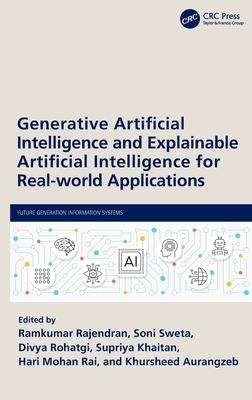
Generative Artificial Intelligence and Explainable Artificial Intelligence for Real-World Applications
暫譯: 生成式人工智慧與可解釋人工智慧的真實世界應用
Rajendran, Ramkumar, Sweta, Soni, Rohatgi, Divya
- 出版商: CRC
- 出版日期: 2026-10-27
- 售價: $9,810
- 貴賓價: 9.5 折 $9,319
- 語言: 英文
- 頁數: 460
- 裝訂: Hardcover - also called cloth, retail trade, or trade
- ISBN: 104106876X
- ISBN-13: 9781041068761
-
相關分類:
GAN 生成對抗網絡、DeepLearning、Machine Learning
海外代購書籍(需單獨結帳)
相關主題


商品描述
This book integrates the concepts of explainable artificial intelligence and generative explainable artificial intelligence, showcasing how explainability can be incorporated into generative models. It highlights the importance of making generative models transparent, offering strategies to achieve this through interpretability techniques.
The book:
- Focuses on the principles and methodologies of explainable artificial intelligence, providing readers with a thorough understanding of how artificial intelligence models can be made transparent and interpretable.
- Explores explainable artificial intelligence techniques, including feature importance, SHAP values, LIME, and counterfactual explanations.
- Offers an in-depth examination of generative artificial intelligence, covering cutting-edge advancements in generative models like GANs, VAEs, and transformer-based architectures.
- Bridges the gap between theoretical concepts and their practical applications, making advanced artificial intelligence technologies accessible to the readers.
- Includes numerous case studies and real-world examples that demonstrate the successful application of generative artificial intelligence, and explainable artificial intelligence.
The text is primarily written for graduate students and academic researchers in electrical engineering, electronics and communication engineering, computer science and engineering, biomedical engineering, and information technology.
商品描述(中文翻譯)
本書整合可解釋人工智慧(explainable artificial intelligence)與生成式可解釋人工智慧(generative explainable artificial intelligence)的概念,展示如何將可解釋性融入生成式模型之中。本書強調讓生成式模型具備透明度的重要性,並透過可解釋性技術提供實現此目標的策略。
本書:
• 聚焦於可解釋人工智慧的原理與方法,讓讀者深入了解如何使人工智慧模型具備透明度與可解釋性。
• 探討可解釋人工智慧技術,包括特徵重要性(feature importance)、SHAP values、LIME,以及反事實解釋(counterfactual explanations)。
• 深入檢視生成式人工智慧,涵蓋 GANs、VAEs 以及以 transformer 為基礎的架構等生成式模型的最新進展。
• 銜接理論概念與實務應用之間的落差,讓讀者能夠理解進階人工智慧技術並應用於實際情境。
• 收錄大量案例研究與真實世界範例,展示生成式人工智慧與可解釋人工智慧的成功應用。
本書主要 dành cho 電機工程、電子與通訊工程、資訊工程、生醫工程及資訊科技領域的研究生與學術研究人員。
作者簡介
Ramkumar Rajendran is an Associate Professor at the Centre for Educational Technology at IITB. Previously, he worked as a research scholar at Vanderbilt University in the USA and as a researcher at NEC Central Research Laboratory in Japan. His research interests include Learning Analytics, AI in Education, Affective Computing, Educational Data Mining, Intelligent Learning environments, and Self-Regulated Learning. Ramkumar received a Ph.D. from the IITB-Monash Research Academy, a joint venture between IITB, India, and Monash University, Melbourne. He served as Program Chair and Track Chair for international conferences, including IEEE T4E, ICALT, LAK, and ICCE. He serves on the Board of Directors for the International Educational Data Mining Society (IEDMS) and is a member of the Executive Committee for the Asia-Pacific Society for Computers in Education and the EdTech Society.
Soni Sweta holds a Ph.D. in Computer Science and Engineering from BIT Mesra, Ranchi, and is currently serving as an Assistant Professor in the Department of Computer Engineering at MPSTME, SVKM's NMIMS, Mumbai. She completed her Master of Technology from Rajiv Gandhi Proudyogiki Vishwavidyalaya, Bhopal. Over the years, she has guided numerous MCA, B.Tech, M.Tech students in their dissertations and final projects, as well as several Ph.D. research scholars.
Her research interests include Artificial Intelligence, Natural Language Processing, Soft Computing, Data Mining, Machine Learning, and Data Science. As a Member of IEEE and a Life Member of CSI (India), she is actively engaged with reputed journals as a reviewer and editorial board member. She has also served on the technical program committees of several esteemed conferences.
Sweta has authored one book, contributed six book chapters, and published multiple high-impact SCI and Scopus-indexed research papers in peer-reviewed international journals. Additionally, she serves as an examiner for various Computer Science courses, including Ph.D. thesis evaluations across several universities in India. With over 18 years of academic experience, she has taught as an Assistant Professor and Visiting Faculty in leading engineering institutions.
Divya Rohatgi is working as Associate Professor, Dept. of CSE at Bharati Vidyapeeth Deemed to be University Department of Engineering & Technology, Navi Mumbai, Maharashtra. She is also acting as HOD IT along with Institution Innovation Council (IIC) Convenor, E-Cell Convenor and IPR Coordinator of the organization. Since past 20 years she has also worked in various reputed engineering colleges of Mumbai University, Amity University and UPTU Lucknow. She is Gate Qualified, Microsoft Technology Associate certified and All India Topper of NPTEL certification for Software Testing by IIT Kharagpur. She is an approved Research Guide in Computer Engineering for PG/ Ph.D programs. She has published research papers in the field of AIML, Software Testing in SCI/Scopus indexed journals and conferences. She has also authored a book on Cyber Law and Cyber Crimes published by reputed publication houses. She has organized various national and international conferences and was session chair in various international conferences. Apart from this she has developed MOOC for Amity Online University and served as reviewer in journals and conferences. She has patents/ copyrights in the field of AI-ML and completed technical consultancy projects. Her area of interests includes Software Engineering, AIML and Deep Learning.
Supriya Khaitan Ph.D. in Computer Science and Engineering is presently working in the Department of Engineering and Technology, Bharati Vidyapeeth, Navi Mumbai, India. She received her Master of Technology degree from Guru Gobind Singh Indraprastha University, Delhi. Supriya Khaitan areas of interest are artificial intelligence, machine learning, deep learning, and network security. She is associated with a few reputed SCI/Scopus journals as a reviewer. She has published many SCI/Scopus-indexed papers in high-impact peer-reviewed international journals; She has authored multiple book chapters;She can be contacted at email: Supriyakhaitan21@gmail.com
Hari Mohan Rai is an Assistant Professor in the Department of Computer Science at the School of Engineering and Digital Sciences, Nazarbayev University, Astana, Kazakhstan. He received his Ph.D. from IIT (ISM) Dhanbad in 2022, where he developed hybrid deep neural network models for early detection of fatal diseases from biomedical signals and images, contributing significantly to AI-driven healthcare diagnostics.
A Gold Medalist in M.Tech. (Control Systems Engineering) from Government Engineering College, Jabalpur, Dr. Rai also holds a B.E. in Electronics and Communication Engineering. He has taught at several international institutions, including International IT University (Kazakhstan), Gachon University (South Korea), NJUPT (China), and Samarkand State University (Uzbekistan), gaining extensive experience in AI, digital systems, and cybersecurity.
His research spans artificial intelligence, biomedical signal and image processing, IoT and robotics, antenna design, and cybersecurity. Rai has published over 50 peer-reviewed papers in leading Q1/Q2 journals such as Bioengineering, Scientific Reports, Sensors, and Expert Systems with Applications. He also holds multiple patents in AI-driven healthcare, smart farming, autonomous drones, and cyber-physical security.
Active in global research communities, he serves as a reviewer and editorial board member for reputed journals and has chaired international conferences. His ongoing work focuses on cancer diagnostics, ECG/EEG analysis, IoT-blockchain systems, and quantum-inspired cryptography.
Khursheed Khursheed is a Professor in the Department of Computer Engineering at the College of Computer and Information, King Saud University, Riyadh. With a Ph.D. in Electronics Design from Midsweden University, Sweden, his doctoral work focused on developing wireless vision sensor networks featuring onboard image processing, compression, and real-time data transmission for machine-monitoring applications. He also holds an MS in Electrical Engineering (System-on-Chip) from Linköping University and a BSc in Computer Engineering from COMSATS IIT Abbottabad.
Dr. Khursheed has extensive academic and research experience across international institutions. Before joining King Saud University, he served as Assistant Professor and Head of Department at Abasyn University, Peshawar, and previously as faculty at COMSATS Institute of Information Technology. His teaching and mentoring span undergraduate and graduate levels, with strong engagement in applied signal processing, digital systems, and machine vision.
His research focuses on signal and image processing, machine vision, wireless visual sensor networks, and embedded system design. He has contributed several peer-reviewed publications in these areas, including work on sub-expression sharing, bi-level image compression, video codecs for embedded vision, and data-reduction techniques. Dr. Khursheed is proficient in MATLAB, digital signal processors, and simulation environments, and is recognized for his creativity, strong work ethic, and commitment to advancing engineering research and education.
作者簡介(中文翻譯)
Ramkumar Rajendran 是 IITB 教育科技中心的副教授。此前,他曾在美國 Vanderbilt University 擔任研究學者,並在日本 NEC Central Research Laboratory 擔任研究員。他的研究興趣包括學習分析(Learning Analytics)、教育人工智慧(AI in Education)、情感運算(Affective Computing)、教育資料探勘(Educational Data Mining)、智慧學習環境(Intelligent Learning Environments)以及自我調節學習(Self-Regulated Learning)。Ramkumar 取得 IITB-Monash Research Academy 的博士學位;該學院是由印度 IITB 與澳洲墨爾本 Monash University 合作成立的研究機構。他曾擔任包括 IEEE T4E、ICALT、LAK 及 ICCE 在內之國際會議的議程主席與主題主席。目前,他擔任 International Educational Data Mining Society(IEDMS)董事會成員,並為 Asia-Pacific Society for Computers in Education 及 EdTech Society 的執行委員會成員。
Soni Sweta 取得 BIT Mesra(Ranchi)的 Computer Science and Engineering 博士學位,目前任職於印度孟買 SVKM's NMIMS 旗下 MPSTME 電腦工程系,擔任助理教授。她於 Bhopal 的 Rajiv Gandhi Proudyogiki Vishwavidyalaya 取得 Master of Technology 學位。多年來,她曾指導許多 MCA、B.Tech 及 M.Tech 學生完成論文與畢業專題,也指導過多位博士研究學者。
她的研究興趣包括人工智慧(Artificial Intelligence)、自然語言處理(Natural Language Processing)、軟計算(Soft Computing)、資料探勘(Data Mining)、機器學習(Machine Learning)及資料科學(Data Science)。身為 IEEE 會員及 CSI(India)終身會員,她積極參與知名期刊的審稿與編輯委員會工作,也曾擔任多場知名會議的技術議程委員。
Sweta 著有一本書,參與撰寫六個書籍章節,並在經同儕審查的國際期刊上發表多篇高影響力、收錄於 SCI 及 Scopus 的研究論文。此外,她也擔任多門 Computer Science 課程的考官,包括印度多所大學的博士論文評審。她擁有超過 18 年的學術經驗,曾在多所知名工程學院擔任助理教授與客座教師。
Divya Rohatgi 任職於 Bharati Vidyapeeth Deemed to be University Department of Engineering & Technology(位於 Maharashtra 的 Navi Mumbai),擔任 Computer Science and Engineering(CSE)系副教授。她同時擔任資訊科技系系主任(HOD IT),以及該機構 Institution Innovation Council(IIC)召集人、E-Cell 召集人與智慧財產權(IPR)協調人。過去 20 年來,她也曾任教於 Mumbai University、Amity University 及 UPTU Lucknow 旗下多所知名工程學院。她通過 GATE 考試,取得 Microsoft Technology Associate 認證,並在 IIT Kharagpur 開設的 Software Testing NPTEL 認證課程中名列全印度第一。她是 Computer Engineering 領域獲核准的研究指導教授,可指導研究所及博士課程。她曾在 SCI/Scopus 收錄的期刊與會議中發表 AIML、Software Testing 領域的研究論文,也曾由知名出版社出版一本關於 Cyber Law 與 Cyber Crimes 的著作。她曾籌辦多場國內與國際會議,並在多場國際會議中擔任議程主席。此外,她也曾為 Amity Online University 開發 MOOC,並擔任期刊與會議審稿人。她在 AI-ML 領域擁有多項專利與著作權,並完成多項技術顧問專案。她的研究興趣包括 Software Engineering、AIML 及 Deep Learning。
Supriya Khaitan 取得 Computer Science and Engineering 博士學位,目前任職於印度 Navi Mumbai Bharati Vidyapeeth 的 Engineering and Technology Department。她於 Delhi 的 Guru Gobind Singh Indraprastha University 取得 Master of Technology 學位。Supriya Khaitan 的研究興趣包括人工智慧、機器學習、深度學習及網路安全。她受邀擔任數本知名 SCI/Scopus 期刊的審稿人。她曾在多本高影響力、經同儕審查的國際期刊上發表多篇 SCI/Scopus 收錄論文,也參與撰寫多個書籍章節。聯絡信箱:Supriyakhaitan21@gmail.com
Hari Mohan Rai 是哈薩克斯坦 Astana Nazarbayev University 工程與數位科學學院 Computer Science 系的助理教授。他於 2022 年取得 IIT(ISM)Dhanbad 博士學位,期間開發用於從生醫訊號與影像中早期偵測致命疾病的混合式深度神經網路模型,對 AI 驅動的醫療診斷作出了重要貢獻。
Rai 博士以 Control Systems Engineering 的 M.Tech 學位畢業於 Government Engineering College, Jabalpur,並獲得金牌;此外,他也取得 Electronics and Communication Engineering 的 B.E. 學位。他曾在多所國際機構任教,包括 International IT University(哈薩克斯坦)、Gachon University(南韓)、NJUPT(中國)及 Samarkand State University(烏茲別克),在 AI、數位系統及資安領域累積了豐富經驗。
他的研究涵蓋人工智慧、生醫訊號與影像處理、IoT 與機器人技術、天線設計及網路安全。Rai 已在 Bioengineering、Scientific Reports、Sensors 及 Expert Systems with Applications 等領先 Q1/Q2 期刊發表超過 50 篇經同儕審查的論文。他也擁有多項與 AI 驅動醫療、智慧農業、自主無人機及資安實體系統相關的專利。
他積極參與全球研究社群,擔任知名期刊的審稿人與編輯委員,也曾主持國際會議。目前的研究工作聚焦於癌症診斷、ECG/EEG 分析、IoT-區塊鏈系統,以及受量子啟發的密碼學。
Khursheed Khursheed 是 Riyadh King Saud University College of Computer and Information Computer Engineering 系的教授。他取得瑞典 Midsweden University 的 Electronics Design 博士學位;博士研究主要著重於開發無線視覺感測器網路,為機器監控應用提供內建影像處理、壓縮及即時資料傳輸功能。他也取得 Linköping University 的 Electrical Engineering(System-on-Chip)碩士學位,以及 COMSATS IIT Abbottabad 的 Computer Engineering 理學士學位。
Khursheed 博士在多所國際機構擁有豐富的教學與研究經驗。在加入 King Saud University 之前,他曾於 Abasyn University(Peshawar)擔任助理教授及系主任,先前也曾任教於 COMSATS Institute of Information Technology。他的教學與指導經驗涵蓋大學部與研究所階段,並長期投入應用訊號處理、數位系統及機器視覺領域。
他的研究聚焦於訊號與影像處理、機器視覺、無線視覺感測器網路及嵌入式系統設計。他在這些領域發表了多篇經同儕審查的論文,研究主題包括子運算式共用(sub-expression sharing)、雙層影像壓縮(bi-level image compression)、嵌入式視覺系統的視訊編解碼器,以及資料縮減技術。Khursheed 博士精通 MATLAB、數位訊號處理器及模擬環境,並以創意、積極的工作態度,以及致力於推動工程研究與教育的精神而受到肯定。