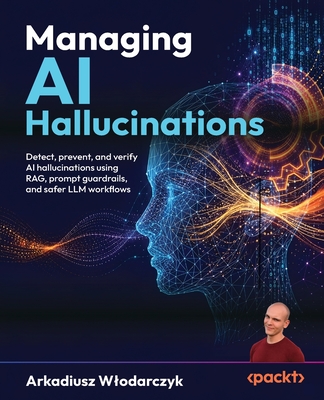
Managing AI Hallucinations: Detect, prevent, and verify AI hallucinations using RAG, prompt guardrails, and safer LLM workflows
暫譯: 管理 AI 幻覺:運用 RAG、Prompt Guardrails 與更安全的 LLM 工作流程偵測、防止並驗證 AI 幻覺
Wlodarczyk, Arkadiusz
- 出版商: Packt Publishing
- 出版日期: 2026-09-29
- 售價: $1,090
- 貴賓價: 9.5 折 $1,035
- 語言: 英文
- 頁數: 98
- 裝訂: Quality Paper - also called trade paper
- ISBN: 1808087933
- ISBN-13: 9781808087936
-
相關分類:
Large language model、Prompt Engineering
海外代購書籍(需單獨結帳)
相關主題

商品描述
Reduce risk from unreliable AI outputs by learning how to detect hallucinations, verify claims, ground responses with RAG, design prompt guardrails, and monitor LLM workflows before flawed answers reach users or decisions.
Key Features:
- Detect fabricated facts, weak citations, outdated claims, and unsafe AI outputs
- Use prompt guardrails, RAG, NotebookLM-style grounding, and model checks to improve LLM reliability
- Apply fact-checking, escalation, logging, and monitoring for safer AI adoption
- Purchase of the print or Kindle book includes a free PDF eBook
Book Description:
AI systems that sound confident can still be wrong. Managing AI Hallucinations gives you a structured, code-driven approach to identifying, preventing, and verifying unreliable LLM output before errors reach users or decisions.
Written by Arkadiusz Wlodarczyk, a programming instructor and course creator with 20+ years of experience, the book works through real code examples and walkthroughs. You will learn why language models produce fabricated facts, false references, and overconfident code. You will reduce hallucinations through system instructions, constraints, and few-shot prompting, and ground responses in trusted sources using RAG, vector databases, and NotebookLM. Cross-model comparison, source checks, and self-consistency prompting give you repeatable ways to evaluate claims.
Later chapters cover guardrails, output validation, logging, and fallback layers alongside compliance requirements, bias risks, and escalation criteria for responsible deployment. The book closes with a monitoring project built on OpenTelemetry, Prometheus, and Grafana. By the end, you will be able to design and monitor AI workflows that catch failures before they reach users.
What You Will Learn:
- Explain why LLMs hallucinate and what makes outputs unreliable
- Detect fabricated facts and false references before they spread
- Reduce hallucinations with prompts, constraints, and guardrails
- Ground responses in trusted sources using RAG and vector databases
- Verify claims with source checks and model comparison for accuracy
- Build reliable AI systems with guardrails, logging, and fallbacks
- Apply compliance checks and bias tests for responsible deployment
- Monitor LLM apps in production with OpenTelemetry and Grafana
Who this book is for:
This book is for Data scientists, AI engineers, developers, technical leads, product managers, compliance professionals, and business teams adopting LLMs in code, content, research, analytics, or decision-support workflows. This book is useful for those who need practical methods to reduce AI hallucinations, validate outputs, and communicate AI limitations clearly. No advanced programming experience is required, but familiarity with LLM tools, APIs, JSON, or command-line workflows will help.
Table of Contents
- Understanding AI Hallucinations
- Preventing Hallucinations
- Detecting and Verifying AI Output
- Deploying AI Responsibly
商品描述(中文翻譯)
透過學習如何偵測幻覺、驗證主張、使用 RAG 為回應提供依據、設計提示防護措施,以及在錯誤答案傳達給使用者或影響決策之前監控 LLM 工作流程,降低不可靠 AI 輸出的風險。
主要特色:
- 偵測捏造的事實、薄弱的引用、過時的主張,以及不安全的 AI 輸出
- 運用提示防護措施(prompt guardrails)、RAG、NotebookLM 式的依據建構,以及模型檢查來提升 LLM 的可靠性
- 應用事實查核、升級處理、記錄與監控,實現更安全的 AI 採用
- 購買紙本書或 Kindle 版本,即可免費取得 PDF 電子書
內容簡介:
聽起來充滿自信的 AI 系統,仍然可能出錯。《Managing AI Hallucinations》提供結構化、以程式碼為核心的方法,協助你在錯誤傳達給使用者或影響決策之前,辨識、防止並驗證不可靠的 LLM 輸出。
本書由擁有 20 多年經驗的程式設計講師與課程創作者 Arkadiusz Wlodarczyk 撰寫,透過實際程式碼範例與逐步操作說明,帶你深入了解相關概念。你將學習語言模型為何會產生捏造的事實、錯誤的參考資料,以及過度自信的程式碼。你也將學會運用系統指令、限制條件與 few-shot prompting 降低幻覺,並透過 RAG、向量資料庫與 NotebookLM,使用可信賴的來源為回應提供依據。跨模型比較、來源檢查與自洽提示(self-consistency prompting),則能提供可重複的方法來評估各項主張。
後續章節將介紹防護措施、輸出驗證、記錄與備援層,並探討合規要求、偏見風險,以及負責任部署所需的升級處理標準。本書最後以 OpenTelemetry、Prometheus 與 Grafana 建立一個監控專案。讀完本書後,你將能夠設計並監控 AI 工作流程,在錯誤傳達給使用者之前加以攔截。
你將學會:
- 說明 LLM 為何會產生幻覺,以及哪些因素會導致輸出不可靠
- 在捏造的事實與錯誤參考資料擴散之前加以偵測
- 使用提示、限制條件與防護措施降低幻覺
- 運用 RAG 與向量資料庫,讓回應以可信賴的來源為依據
- 透過來源檢查與模型比較驗證主張的正確性
- 使用防護措施、記錄與備援機制,建立可靠的 AI 系統
- 應用合規檢查與偏見測試,實現負責任的部署
- 使用 OpenTelemetry 與 Grafana 監控正式環境中的 LLM 應用程式
適合閱讀本書的讀者:
本書適合資料科學家、AI 工程師、開發人員、技術主管、產品經理、合規專業人員,以及在程式碼、內容、研究、分析或決策支援工作流程中採用 LLM 的企業團隊。對於需要實務方法來降低 AI 幻覺、驗證輸出,並清楚傳達 AI 限制的讀者,本書尤其實用。不要求具備進階程式設計經驗,但若熟悉 LLM 工具、API、JSON 或命令列工作流程,將有助於理解本書內容。
目錄
- 了解 AI 幻覺
- 防止幻覺
- 偵測與驗證 AI 輸出
- 負責任地部署 AI