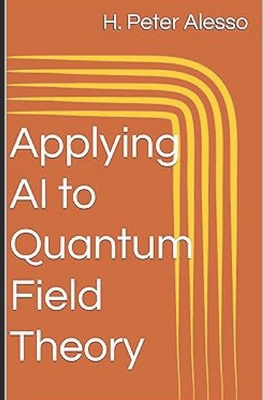
Applying AI to Quantum Field Theory
暫譯: 將人工智慧應用於量子場論
Alesso, H. Peter
- 出版商: Independently Published
- 出版日期: 2025-08-19
- 售價: $1,010
- 貴賓價: 9.5 折 $959
- 語言: 英文
- 頁數: 214
- 裝訂: Quality Paper - also called trade paper
- ISBN: 9798298713795
- ISBN-13: 9798298713795
-
相關分類:
Machine Learning、量子 Quantum
海外代購書籍(需單獨結帳)
相關主題


商品描述
In 2019, Giuseppe Carleo and his team pioneered the application of machine learning to quantum physics. This book is an introduction to how AI revolutionizes quantum field theory (QFT), from scalar fields to complex gauge theories describing quarks and gluons. The narrative unfolds in three acts. First, readers discover the mathematical kinship between neural networks and quantum fields-the renormalization group maps onto information flow through neural layers, while gauge symmetry provides blueprints for AI architectures. Through Python code, readers build networks that discover phase transitions without being taught physics, demonstrating AI's ability to rediscover fundamental principles from data alone. The second act examines how AI addresses each type of quantum field. For scalar fields, neural networks identify exotic phases that traditional methods miss. For fermions, architectures like FermiNet achieve chemical accuracy while sidestepping computational barriers. For gauge fields, flow-based models conquer critical slowing down that has limited simulations for decades. Key breakthroughs include MIT's gauge-equivariant flows, which reduce autocorrelation times by a factor of 100, DeepMind's solution to 30-electron molecules, and the discovery by transformers that million-term scattering amplitudes can be expressed as a single equation. The final act envisions AI not just calculating but creating physics systems like MELVIN, designing quantum experiments that no human has imagined. Language models solve bootstrap equations. Neural networks propose routes to grand unification. The book culminates in a convergence of quantum computers and classical AI-a partnership that could crack QFT's deepest mysteries. By teaching AI nature's symmetries, we're creating systems that reveal patterns invisible to human analysis-AI intelligence is offering a different way of interrogating reality. Written as an introduction for physicists curious about AI and ML, as well as for AI and ML experts interested in fundamental physics, the book strikes a balance between rigor and practical implementation, offering both conceptual frameworks and tools for the quantum field theory revolution.
商品描述(中文翻譯)
在2019年,Giuseppe Carleo及其團隊開創了將機器學習應用於量子物理的先河。本書介紹了人工智慧如何徹底改變量子場論(QFT),從標量場到描述夸克和膠子的複雜規範理論。
敘述分為三個部分。首先,讀者將發現神經網絡與量子場之間的數學親緣關係——重正化群映射到神經層中的信息流,而規範對稱則為人工智慧架構提供藍圖。通過Python代碼,讀者構建網絡,能夠在未學習物理的情況下發現相變,展示了人工智慧僅從數據中重新發現基本原則的能力。
第二部分探討人工智慧如何處理每種類型的量子場。對於標量場,神經網絡能夠識別傳統方法所忽略的奇異相。對於費米子,像FermiNet這樣的架構在不突破計算障礙的情況下達到了化學精度。對於規範場,基於流的模型克服了限制模擬數十年的臨界減速。關鍵突破包括麻省理工學院的規範等變流,將自相關時間縮短了100倍,DeepMind對30電子分子的解決方案,以及變壓器發現的百萬項散射振幅可以用一個方程表示。
最後一部分展望人工智慧不僅僅是計算,而是創造物理系統,如MELVIN,設計出人類從未想像過的量子實驗。語言模型解決自引導方程。神經網絡提出大統一的路徑。本書的高潮在於量子計算機與經典人工智慧的融合——這種合作可能破解量子場論最深奧的謎題。
通過教導人工智慧自然的對稱性,我們正在創造揭示人類分析無法看見的模式的系統——人工智慧的智慧提供了一種不同的方式來探究現實。
本書作為對於對人工智慧和機器學習感興趣的物理學家的入門書,以及對基本物理感興趣的人工智慧和機器學習專家的參考,平衡了嚴謹性和實際應用,提供了量子場論革命的概念框架和工具。