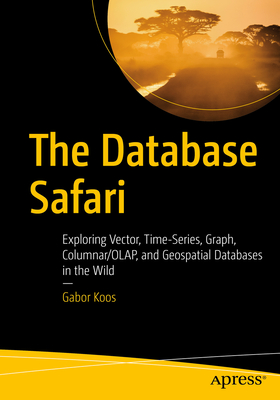
The Database Safari: Exploring Vector, Time-Series, Graph, Columnar/Olap, and Geospatial Databases in the Wild
暫譯: 資料庫 Safari:深入探索實戰中的向量、時間序列、圖形、欄式/OLAP 與地理空間資料庫
Koos, Gabor
相關主題

商品描述
Pack your field kit--this is a guided safari through today's database ecosystem. In the wild, one size rarely fits all: Modern systems often need specialized databases to deliver real-world performance and scale. This book is a practical field guide to those less commonly used databases--vector, time-series, graph, columnar/OLAP, geospatial, event-stream, and more. It shows you how each engine works, where it excels, and how to choose the right engine for each workload. The book provides clear trade-off tables, indexing strategies, query patterns, and use-case recipes you can apply immediately.
Starting with foundations in SQL and NoSQL, this book explores each "species" chapter by chapter, emphasizing hands-on scenarios and pitfalls to avoid. It then brings everything together in polyglot/hybrid architectures, helping you combine engines confidently, whether you're designing a similarity search with vector databases (ANN), building observability pipelines on time-series data and event logs, modeling relationships in graph databases, or delivering analytics with columnar/OLAP and geospatial queries. The result is a concise, engineer-first map of the database landscape that turns theory into pragmatic decision-making.
What You Will Learn
- Identify the right engine for the job across vector, time-series, graph, columnar/OLAP, geospatial, and event-stream databases
- Evaluate trade-offs in performance, scalability, consistency, storage layout, indexing, and operational complexity
- Design polyglot architectures that combine multiple engines (e.g., vector + OLAP + event-stream) for end-to-end solutions
- Apply use-case patterns for similarity search (ANN), observability metrics, fraud/network analysis, geospatial routing, and analytical reporting
- Understand core internals that matter (index types, retention policies, log-structured storage, spatial indexes, columnar execution) without vendor lock-in
- Avoid common pitfalls in schema design, query planning, and cross-engine data movement
- Build a decision checklist and trade-off tables to justify engine selection to stakeholders
Who This Book Is For
Software engineers; back-end developers; data engineers; system architects; site reliability engineers (SREs); technical leads with basic SQL/NoSQL experience who need practical guidance to select, compare, and combine specialized databases for real-world applications
商品描述(中文翻譯)
準備好你的實地勘查工具包——這是一趟探索當今資料庫生態系的導覽之旅。在這片充滿變化的環境中,單一方案很少能滿足所有需求:現代系統通常需要專用資料庫,才能實現真實世界所要求的效能與擴充性。本書是一份實用的實地指南,帶你認識那些較少被使用的資料庫,包括向量資料庫、時間序列資料庫、圖形資料庫、欄式/OLAP 資料庫、地理空間資料庫、事件串流資料庫等。本書將說明每種資料庫引擎的運作方式、適用場景,以及如何針對不同工作負載選擇合適的引擎。書中提供清楚的取捨比較表、索引策略、查詢模式與使用案例配方,讓你能立即應用。
本書從 SQL 與 NoSQL 的基礎開始,逐章探索每一種「物種」,著重於實作情境以及應避免的常見陷阱。接著,內容會在多語言/混合式架構中整合這些概念,協助你有信心地組合不同引擎:無論是使用向量資料庫(ANN,近似最近鄰)設計相似度搜尋、以時間序列資料與事件日誌建構可觀測性管線、在圖形資料庫中建立關係模型,或是透過欄式/OLAP 與地理空間查詢提供分析能力。本書最終將以精簡、工程師導向的方式,描繪資料庫版圖,將理論轉化為務實的決策依據。
你將學會
• 在向量、時間序列、圖形、欄式/OLAP、地理空間與事件串流資料庫之間,辨識適合特定工作的引擎
• 評估效能、擴充性、一致性、儲存配置、索引與營運複雜度等面向的取捨
• 設計結合多個引擎的多語言架構(例如向量資料庫 + OLAP + 事件串流),打造端到端解決方案
• 套用相似度搜尋(ANN,近似最近鄰)、可觀測性指標、詐欺/網路分析、地理空間路由與分析報表等使用案例模式
• 了解重要的核心內部機制,包括索引類型、資料保留政策、日誌結構化儲存、空間索引與欄式執行,同時避免受制於特定供應商
• 避免結構描述設計、查詢規劃與跨引擎資料移動中的常見陷阱
• 建立決策檢查清單與取捨比較表,向利害關係人說明並證明引擎選擇的合理性
本書適合讀者
軟體工程師、後端開發人員、資料工程師、系統架構師、網站可靠性工程師(SRE),以及具備基本 SQL/NoSQL 經驗,並需要實用指南來為真實世界的應用程式選擇、比較與組合專用資料庫的技術主管。
作者簡介
Gabor Koos is a software engineer and technical writer based in London, England, United Kingdom, specializing in backend systems, distributed architectures, and modern database technologies. He has designed and built large-scale, data-intensive platforms across media, online gaming, finance, and government, with a focus on database design, performance optimization, and scalable system architectures. He also maintains open-source projects that support developer tooling and data processing.
作者簡介(中文翻譯)
Gabor Koos 是一名居住於英國英格蘭倫敦的軟體工程師與技術作家,專精於後端系統、分散式架構及現代資料庫技術。他曾在媒體、線上遊戲、金融與政府等領域,設計並建置大規模、資料密集型平台,專注於資料庫設計、效能最佳化與可擴充的系統架構。他也維護支援開發者工具與資料處理的開放原始碼專案。