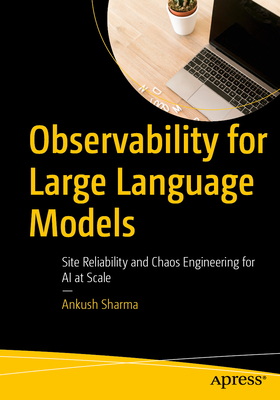
Observability for Large Language Models: Site Reliability and Chaos Engineering for AI at Scale (Paperback)
暫譯: 大型語言模型的可觀察性:AI 大規模運行的網站可靠性與混沌工程 (平裝本)
Sharma, Ankush
- 出版商: Apress
- 出版日期: 2026-06-26
- 售價: $1,970
- 貴賓價: 9.5 折 $1,871
- 語言: 英文
- 頁數: 236
- 裝訂: Quality Paper - also called trade paper
- ISBN: 9798868828263
- ISBN-13: 9798868828263
-
相關分類:
Large language model
立即出貨 (庫存=1)
相關主題

商品描述
This book is a comprehensive guide designed to equip engineers, data scientists, and AI practitioners with the principles, tools, and strategies needed to ensure reliability, performance, and accountability in Large Language Models (LLMs).
The book begins by laying the groundwork with the foundations of observability, introducing LLMs, their significance in modern AI, and the critical role observability plays in maintaining robust systems. It then explores SRE principles, service level objectives, and incident response, while distinguishing the unique observability challenges that arise in AI and ML systems. Building on this foundation, the book dives into measuring performance, from defining SLOs tailored for LLMs to monitoring computational and token-level metrics. Readers gain practical insights into structured logging, debugging, and distributed tracing methods that provide visibility into complex LLM workflows. Scaling challenges are addressed through strategies for cross-model observability, autoscaling, latency reduction, and fault-tolerant infrastructure design. The book further explores chaos engineering, guiding readers through resilience testing in LLMs and the automation of chaos experiments in CI/CD pipelines. Finally, it highlights monitoring, retraining, and ethical considerations in AI observability, including governance, privacy, and accountability.
In conclusion, this book provides a holistic roadmap to building reliable, transparent, and future-ready LLM systems.
What you will learn:
- How to design observability pipelines for LLMs, including token-level logging, prompt tracing, and
latency analysis.
- Techniques for applying chaos engineering principles to test LLM robustness under stress and
failure scenarios.
- Methods for building SLOs, SLAs, and dashboards tailored to inference quality and model
reliability.
- Strategies for monitoring hallucinations, drift, bias, and ethical failures in real-time.
Who this book is for:
This book is for AI infrastructure engineers, SREs, machine learning platform teams, and applied AI practitioners deploying or maintaining LLM-based applications.
商品描述(中文翻譯)
這本書是一本全面的指南,旨在為工程師、數據科學家和人工智慧(AI)從業者提供確保大型語言模型(LLMs)可靠性、性能和問責所需的原則、工具和策略。
本書首先奠定了可觀察性的基礎,介紹了LLMs及其在現代AI中的重要性,以及可觀察性在維護穩健系統中的關鍵角色。接著探討了SRE原則、服務水平目標(SLOs)和事件響應,同時區分了在AI和機器學習(ML)系統中出現的獨特可觀察性挑戰。在此基礎上,本書深入探討性能測量,從為LLMs量身定制的SLOs定義到監控計算和標記級別的指標。讀者將獲得有關結構化日誌、除錯和分佈式追蹤方法的實用見解,這些方法提供了對複雜LLM工作流程的可見性。通過跨模型可觀察性、自動擴展、延遲減少和容錯基礎設計的策略來解決擴展挑戰。本書進一步探討了混沌工程,指導讀者在LLMs中進行韌性測試以及在CI/CD管道中自動化混沌實驗。最後,強調了AI可觀察性中的監控、再訓練和倫理考量,包括治理、隱私和問責。
總之,本書提供了一個全面的路線圖,以建立可靠、透明和未來準備好的LLM系統。
您將學到的內容:
- 如何為LLMs設計可觀察性管道,包括標記級別的日誌、提示追蹤和延遲分析。
- 應用混沌工程原則來測試LLM在壓力和故障情境下的穩健性的方法。
- 建立針對推理質量和模型可靠性的SLOs、SLA和儀表板的方法。
- 實時監控幻覺、漂移、偏見和倫理失敗的策略。
本書的讀者對象:
本書適合AI基礎設施工程師、SRE、機器學習平台團隊以及部署或維護基於LLM的應用程序的應用AI從業者。
作者簡介
Ankush Sharma is a veteran technologist and AI systems architect with over 20 years of expertise in distributed systems, cloud infrastructure, and AI platform engineering. He has led engineering teams at leading global technology companies and has been an active contributor to open-source AI infrastructure projects. His work has been recognised through conference talks, patents, and leading developer forums. He is based in the Bay Area, US.
作者簡介(中文翻譯)
Ankush Sharma 是一位資深技術專家和人工智慧系統架構師,擁有超過 20 年的分散式系統、雲端基礎設施和人工智慧平台工程的專業知識。他曾在全球領先的科技公司領導工程團隊,並積極參與開源人工智慧基礎設施專案。他的工作透過會議演講、專利和領先的開發者論壇獲得了認可。他目前居住在美國灣區。