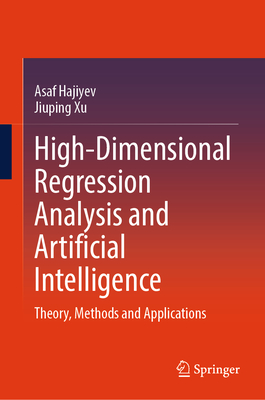
High-Dimensional Regression Analysis and Artificial Intelligence: Theory, Methods and Applications
暫譯: 高維回歸分析與人工智慧:理論、方法與應用
Hajiyev, Asaf, Xu, Jiuping
- 出版商: Springer
- 出版日期: 2026-01-03
- 售價: $8,320
- 貴賓價: 9.5 折 $7,904
- 語言: 英文
- 頁數: 439
- 裝訂: Hardcover - also called cloth, retail trade, or trade
- ISBN: 9819525136
- ISBN-13: 9789819525133
-
相關分類:
Machine Learning、Python
海外代購書籍(需單獨結帳)
商品描述
In this book, a novel high-dimensional linear and nonlinear regression model is introduced to address, in part, the challenges of evaluating the stability and confidence of large-scale models' interpretability. The book begins by reviewing foundational concepts in regression analysis, and discussing the current state and challenges of AI interpretability. Through an in-depth exploration of regression models, the core principles of data-driven linear regression are explained. To enhance the explanatory power of regression models, variable-parameter regression models are further investigated and extended to variable-parameter nonlinear regression models. To handle complex relationships, the Gauss-Newton iterative method is incorporated, ensuring the stability of high-dimensional nonlinear regression. The Confidence Interval-based Credibility Evaluation (CICE) framework combines statistical indicators--such as interval width, center deviation, and accuracy--into a single score to assess the stability and reliability of explanations, validated through case studies in engineering, finance, and time series prediction. Overall, the book presents a coherent framework for interpretable AI, integrating regression modeling, confidence region construction, and credibility evaluation to enhance interpretability and statistical accountability, fostering more trustworthy AI systems. Chapter 1 introduces the fundamental concepts and theoretical developments of both regression analysis and AI explainability, highlighting their interconnections. Chapter 2 reviews essential probability theory and mathematical statistics, covering random variables, measure spaces, probability distributions, parameter estimation (including least squares and maximum likelihood methods), and asymptotic theory, which serve as the foundation for analyzing model consistency and convergence. Chapter 3 focuses on the effects of correlated errors in linear regression, establishing parameter convergence conditions to ensure the consistency and asymptotic normality of covariance estimators. Chapter 4 introduces variable-parameter regression models and systematically studies M-estimators and generalized regression models within the framework of robust statistics. By addressing non-normal errors and outliers, these methods improve model adaptability. The chapter also establishes the robustness of the generalized regression model through theoretical analysis of covariance estimation. Chapter 5 introduces the Confidence Interval-based Credibility Evaluation (CICE) framework, which integrates multiple statistical indicators into a unified score to assess the stability and reliability of model explanations. Through real-world case studies in engineering, finance, and time series prediction, the effectiveness of CICE in detecting unstable interpretations and enhancing model transparency is demonstrated.
商品描述(中文翻譯)
在本書中,介紹了一種新穎的高維線性和非線性回歸模型,以部分解決評估大規模模型可解釋性穩定性和信心的挑戰。本書首先回顧回歸分析的基礎概念,並討論人工智慧可解釋性的現狀和挑戰。通過對回歸模型的深入探索,解釋了數據驅動的線性回歸的核心原則。為了增強回歸模型的解釋能力,進一步研究了變量參數回歸模型,並擴展到變量參數非線性回歸模型。為了處理複雜的關係,納入了高斯-牛頓迭代法,以確保高維非線性回歸的穩定性。基於信賴區間的可信度評估(CICE)框架將統計指標(如區間寬度、中心偏差和準確性)結合成一個單一分數,以評估解釋的穩定性和可靠性,並通過工程、金融和時間序列預測的案例研究進行驗證。總體而言,本書提出了一個連貫的可解釋人工智慧框架,整合了回歸建模、信賴區域構建和可信度評估,以增強可解釋性和統計責任,促進更值得信賴的人工智慧系統。第一章介紹了回歸分析和人工智慧可解釋性的基本概念和理論發展,強調它們之間的相互關聯。第二章回顧了基本的概率論和數學統計,涵蓋隨機變量、測度空間、概率分佈、參數估計(包括最小二乘法和最大似然法)以及漸近理論,這些都是分析模型一致性和收斂性的基礎。第三章專注於線性回歸中相關誤差的影響,建立參數收斂條件,以確保協方差估計量的一致性和漸近正態性。第四章介紹了變量參數回歸模型,並在穩健統計的框架內系統研究M-估計量和廣義回歸模型。通過處理非正態誤差和異常值,這些方法提高了模型的適應性。本章還通過對協方差估計的理論分析,確立了廣義回歸模型的穩健性。第五章介紹了基於信賴區間的可信度評估(CICE)框架,該框架將多個統計指標整合為統一分數,以評估模型解釋的穩定性和可靠性。通過在工程、金融和時間序列預測中的實際案例研究,展示了CICE在檢測不穩定解釋和增強模型透明度方面的有效性。
作者簡介
This book is the result of a longstanding collaboration between two leading scholars. Professor Asaf Hajiyev, a full member of the Azerbaijan National Academy of Sciences, is renowned for his work in probability theory, mathematical statistics, and stochastic modeling. He has authored over 150 scientific papers and several books, and currently heads the Department of Statistical Modeling at the Institute of Control Systems.
Professor Jiuping Xu, Distinguished Professor at Sichuan University and academician of several international academies, specializes in foundational modeling for computer science and management science. He has led over 80 national research projects and published more than 900 papers and 40 books. Together, their teams have developed innovative methodologies to evaluate the stability of AI interpretability using regression-based confidence regions. Their interdisciplinary partnership, active since 2010, combines theoretical rigor with practical insight to support robust and explainable decision-making in artificial intelligence.
作者簡介(中文翻譯)
這本書是兩位領先學者長期合作的成果。阿塞拜疆科學院的全職成員阿薩夫·哈吉耶夫教授,以其在機率論、數學統計和隨機建模方面的研究而聞名。他已發表超過150篇科學論文和幾本書籍,目前擔任控制系統研究所的統計建模系主任。
徐久平教授是四川大學的特聘教授,並且是多個國際學術院的院士,專注於計算機科學和管理科學的基礎建模。他主導了超過80個國家研究項目,並發表了超過900篇論文和40本書籍。兩位教授及其團隊共同開發了創新的方法論,以回歸基礎的信心區域評估人工智慧可解釋性的穩定性。他們自2010年以來的跨學科合作,結合了理論的嚴謹性和實踐的洞察力,以支持人工智慧中的穩健和可解釋的決策制定。